Assortment planning sits at the intersection of consumer demand, operational constraints, and commercial strategy. Traditionally, this function has relied on retrospective analysis and incremental adjustments—an approach that is increasingly misaligned with today’s volatile, competitive, and highly localized retail landscape. Post-pandemic shifts in consumer behavior, coupled with channel proliferation and SKU explosion, have created a compelling case for systemic AI-led transformation in assortment planning.
This article explores the limitations of legacy assortment paradigms, the growing need for localization and channel harmonization, and how a combination of AI and intelligent automation can fundamentally reshape how assortments are planned, optimized, and executed at scale.
The Legacy Paradigm: “Wait and Watch”
Historically, assortment planning has been guided by a “wait and watch” philosophy. Planners typically analyze historical performance, observe early signals, and make cautious adjustments over extended planning cycles. While this approach offered stability in relatively predictable markets, it now leads to missed growth opportunities in dense and highly competitive environments.
Consumer preferences have undergone structural changes in the post-COVID era. Shifts in brand loyalty, increased price sensitivity, altered consumption patterns, and experimentation with new channels have made demand less predictable and more fragmented. These trends are evident in the performance of major CPG firms, many of which have reported revenue growth driven primarily by price increases rather than volume expansion—highlighting the fragility of demand and the limitations of reactive planning.
In such an environment, relying on lagging indicators and manual analysis constrains an organization’s ability to anticipate change, respond quickly, and unlock incremental growth.
The Growing Need for Localization
Rapidly evolving consumer behavior has amplified the need for localized assortment strategies. Preferences now vary significantly by geography, store format, demographic cohort, and occasion. However, legacy assortment processes often rely on a standardized, global framework that is applied uniformly across markets.
This one-size-fits-all approach struggles to accommodate:
- Regional differences in taste, price elasticity, and brand affinity
- Store-level constraints such as space, supply variability, and fulfillment models
- The increasing breadth and depth of SKU portfolios
As organizations expand across multiple markets and channels, the complexity of assortment planning grows exponentially. Manual or semi-manual processes cannot scale effectively in such environments. To remain competitive, assortment planning must become intelligently automated and systemized—capable of generating localized, context-aware recommendations while maintaining enterprise-wide coherence.
Harmonizing Online and Offline Channels
The rapid rise of e-commerce and quick commerce has fundamentally challenged the dominance of traditional offline channels. What began as a competitive threat has evolved into a new consumer experience paradigm, where shoppers engage across multiple touchpoints before making purchase decisions.
Consumers exhibit distinct behaviors across channels—varying in basket composition, price sensitivity, frequency, and responsiveness to promotions. Yet, these engagement paths often converge at multiple points in the customer lifecycle. Unlocking value from this convergence requires deliberate channel harmonization.
This harmonization can occur at two levels of sophistication:
Level A: Deep Harmonization
At this level, organizations establish shared data systems, unified KPIs, and aligned stakeholder structures across channels. Assortment decisions are made holistically, with online and offline channels treated as interdependent components of a single ecosystem.
Level B: Insight Harmonization
Here, insights generated in one channel are leveraged to inform decisions in another. For example, emerging demand patterns or rapid trend adoption observed in online channels can be used as leading indicators to anticipate offline demand shifts.
Both levels require robust data integration and advanced analytics capabilities—foundational elements for AI-driven assortment planning.
Systemic AI Transformation in Assortment Planning
Assortment planning is inherently complex. It involves multiple stakeholders, disparate data systems, localized strategies, varying constraints, and the need to evaluate dynamic scenarios. These characteristics make it an ideal candidate for AI-led transformation.
While AI and automation are often used interchangeably, a truly effective solution combines both:
- Automation handles repetitive, rule-based tasks such as data aggregation, performance tracking, and baseline reporting.
- AI augments human decision-making by identifying patterns, prioritizing insights, and generating forward-looking scenarios.
In the traditional model, a category planner might analyze the past two weeks of performance and manually extrapolate likely outcomes for the next month. In an AI-enabled model, automated systems continuously analyze performance signals, while AI engines generate multiple optimized scenarios—allowing planners to focus on strategic decisions rather than manual analysis.
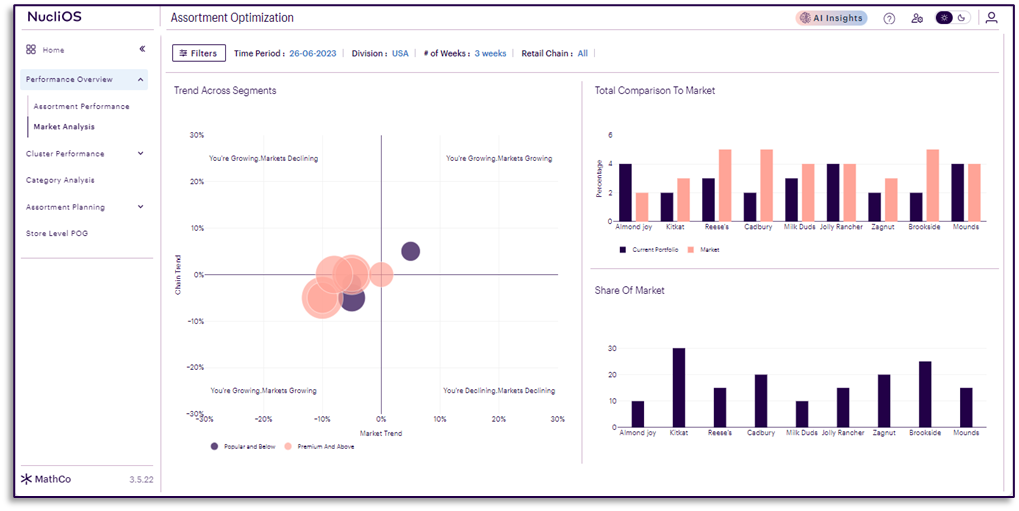
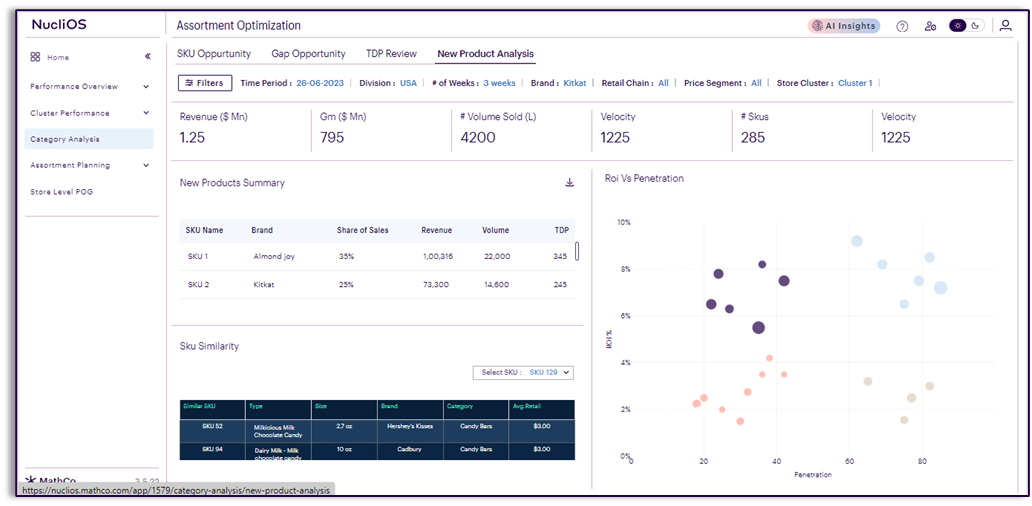
This shift transforms planners from reactive analysts into proactive orchestrators of growth.
Key Value Adds of an AI-Led Assortment Solution
A systemic AI transformation in assortment planning delivers several critical benefits:
- Adaptive Granularity: The ability to adjust the granularity of planning—from national to regional, store-level, or even micro-segment level—enables truly localized assortment strategies.
- Explainable Decision Logic: An explainable AI engine prioritizes insights and leading indicators, ensuring transparency and trust in recommendations while supporting faster decision-making.
- Agile Optimization: Assortment plans can be continuously optimized in response to changing demand signals, supply constraints, and competitive dynamics—far more agile than traditional team-based planning frameworks.
Databricks Readiness:
- Databricks-native metadata-driven framework to ingest, harmonize, and curate POS, product, store, pricing, and promotion data on the Lakehouse
- Reusable Databricks ML accelerators for large-scale granular demand forecasting and assortment optimization model training and deployment
- AI agents for automated assortment scenario generation, prescriptive recommendations, and explainable decisioning, enabled by NucliOS and built on Agent Bricks
- Production-ready Databricks operational accelerators for workload orchestration, performance optimization, and cost-efficient scaling
Case Study: AI-Enabled Assortment Planner for a Global CPG Company
Problem Statement
The client, a global CPG company, had dedicated strategists and managers for assortment planning, but decision-making relied heavily on spreadsheets and rigid, non-customizable tools. This fragmented approach limited scalability, reduced transparency, and constrained the ability to simulate complex assortment scenarios.
Solution
To address these challenges, MathCo modernized the client’s assortment planning on a Databricks Lakehouse, centralizing disparate data sources into a unified, analytics-ready environment. AI agents built on Agent Bricks automated scenario generation, enabling rapid exploration of multiple assortment strategies across categories, regions, and channels. The solution provided prescriptive recommendations and explainable, AI-driven insights to support decision-making, while dashboards and interactive tools allowed planners to simulate “what-if” scenarios with ease. By combining automation, scalable data infrastructure, and advanced AI, the client could make faster, more informed, and data-driven assortment decisions while reducing reliance on manual spreadsheets and rigid planning tools.
Impact
- Unified Assortment Planning Platform: Consolidated planning activities into a one-stop solution with built-in version control, improving collaboration and governance.
- Scenario Simulation Across SKUs and Brands: Enabled simulation of SKU conversions within and across brands, supporting informed portfolio optimization decisions.
- Demand Transference and Cannibalization Analysis: Integrated metrics and analytical capabilities to measure demand transference, substitution effects, and product cannibalization.
- Competitive Landscape Visibility: Delivered a detailed view of competitors and their impact on product performance, strengthening strategic decision-making.
Conclusion: From Reactive Planning to Proactive Growth
Assortment planning is no longer a static, retrospective exercise. In an environment defined by rapid consumer shifts, channel convergence, and expanding SKU complexity, organizations must move beyond legacy “wait and watch” paradigms.
A systemic AI-led transformation—anchored in intelligent automation, explainable decision logic, localized optimization, and scalable platforms, enables planners to anticipate change rather than react to it. By harmonizing insights across channels, empowering localized decision-making, and embedding AI into daily planning workflows, enterprises can transform assortment planning into a sustained engine of growth.
The future of assortment planning lies not in replacing human expertise, but in augmenting it—enabling planners to act with speed, confidence, and precision in an increasingly complex retail ecosystem.