Retail customers today are more digitally enabled and informed than ever before. Products, prices, reviews, and recommendations are available instantly across multiple channels, empowering customers to make fast and dynamic decisions. This proliferation of channels—online, mobile, social, and in-store—has significantly raised the bar for retailers, who must now curate seamless and consistent experiences across every customer touchpoint.
At the same time, customers are increasingly driven by price, promotions, availability, and convenience. As a result, traditional notions of loyalty and brand affinity are under constant pressure. To remain relevant and competitive, retailers must extend the essence of their in-store experience into digital channels—ensuring that they remain present in both the hands and minds of their customers throughout the buying journey.
New Problems, Familiar Challenges
The transformation of the retail landscape has been nothing short of profound. Brick-and-mortar stores are no longer the default channel, and customer data can no longer be captured in simple, isolated databases. While this evolution has unlocked new growth opportunities, it has also amplified longstanding challenges.
The principle of “garbage in, garbage out” remains highly relevant—particularly in the context of customer data. Accurately mapping purchases, visits, and interactions to individual customers has become increasingly difficult. Identifying the same customer across online and offline channels is an even greater challenge. Without reliable customer identity and data quality, activating business strategies—such as personalization, targeted marketing, or loyalty programs—remains largely theoretical.
The Rise of the Customer Data Platform (CDP)
In response to these challenges, the retail industry has embraced the Customer Data Platform (CDP) as a foundational solution. CDPs promise to unify customer data from multiple sources into a single, comprehensive view of the customer. Positioned at the center of retail operations, CDPs are expected to power everything from personalization and marketing to retail media and customer engagement.
The market has responded with a wide array of CDP solutions, and adoption among retailers has been rapid, making CDPs one of the most widely implemented modern retail technologies.
Challenges with CDP Adoption
As with any new technology, CDPs have also exposed underlying issues that were previously underestimated. Two challenges, in particular, have emerged as critical.
The first is data—not only in terms of quality, but availability. Mapping customers across online and offline channels is not merely a cleansing problem; it is often an architectural one. Digital interactions and in-store transactions generate fundamentally different data footprints, making direct linkage difficult. Addressing this challenge requires rethinking data features and employing advanced techniques—such as heuristics and machine learning—to achieve the most accurate customer matches possible.
The second challenge is adoption. The value of any platform is ultimately determined by how effectively it is used. If CDPs are not actively consumed by business teams or embedded into decision-making workflows, their impact remains limited. Together, these challenges underscore the need for solutions that are not only technologically robust but also tailored to the unique context of each retailer.
The Journey to Mapping the Customer
Customer identity resolution sits at the heart of any successful CDP initiative. While the problem may appear straightforward, the solution is inherently multifaceted. It requires the convergence of data engineering, advanced analytics, domain expertise, and business context.
Retail context, in particular, plays a critical role. For example, customers in a fashion retail environment exhibit very different browsing and purchasing behaviors compared to those in a home improvement setting. Recognizing these differences is essential for designing effective identity resolution strategies. A combination of heuristics, analytical techniques, and a structured framework provides the foundation for addressing this complexity.
Activating the CDP
Deploying a CDP is only the first step. Real value is unlocked through activation—by democratizing customer data and converting it into actionable insights aligned to key business drivers and customer touchpoints.
CDP activation requires modular, highly customizable solutions that can adapt to variations across categories, regions, channels, and use cases. Without a clear activation roadmap and a robust set of supporting capabilities, CDP investments risk falling short of their potential. Activation transforms CDPs from passive data repositories into engines that drive personalization, loyalty, marketing effectiveness, and customer experience.
MathCo Customer Suite
To address these challenges, MathCo developed a hybrid solution that balances the flexibility of custom-built systems with the speed of plug-and-play products. The MathCo Customer Suite delivers retail- and context-aware accelerators across the customer lifecycle—spanning identity resolution, loyalty, personalization, and engagement.
Designed to integrate seamlessly with a retailer’s existing CDP of choice, the solution minimizes change management while offering deep customization based on data, technology, and business context. This approach accelerates time-to-value, improves business impact, and reduces overall investment—an especially critical advantage in today’s highly competitive retail environment.
Databricks Readiness
The solution is built on a Databricks Lakehouse foundation to ensure scalability, performance, and governance:
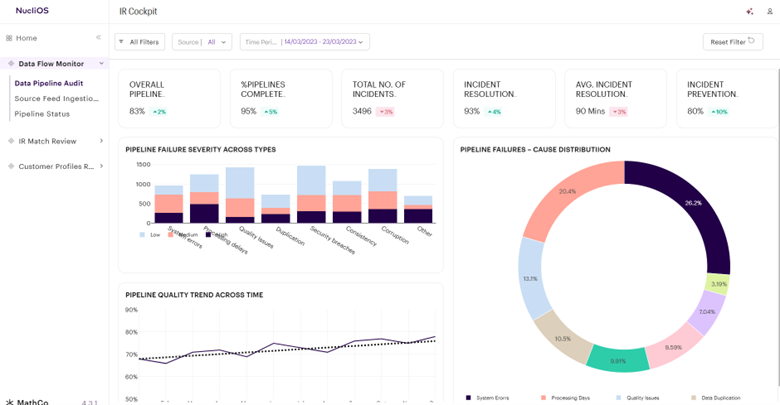
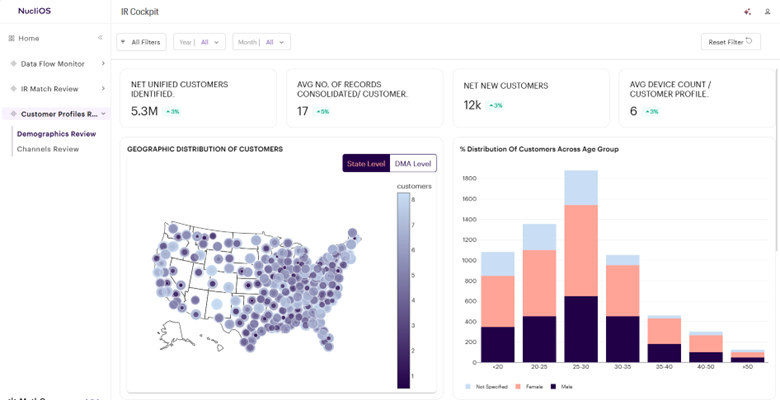
- Lakehouse-driven data and data model accelerators to ingest, standardize, and unify omnichannel customer data across retail, e-commerce, marketing, and loyalty systems into a consolidated Customer 360
- Identity resolution and deduplication accelerators combining deterministic logic and ML-driven rules to reduce duplicates and improve profile accuracy
- Unity Catalog–based governance and PII migration accelerators to enforce fine-grained access control and regulatory compliance
- Databricks-compatible ML accelerators for customer segmentation, propensity modeling, and campaign optimization
- Production-grade operational accelerators to support continuous customer profile refreshes with scalable performance and optimized compute costs
Case Study: Customer360 Platform for a Global Fashion Retailer
Problem Statement
A leading global fashion retailer faced significant challenges due to fragmented and disorganized customer data, which directly impacted marketing and advertising effectiveness. Customer information was spread across multiple omnichannel platforms, with complex integration requirements and strict data accuracy and compliance standards.
MathCo proposed the creation of a CDP-enabled Customer 360 platform to centralize, organize, and govern customer data—providing a single, accessible source of truth to support targeted marketing and personalization.
Impact
- Reduced duplicate customer records by 30% by leveraging Databricks-native MathCo IR Accelerator to unify customer identities
- Cut reported data quality issues by 95% through a scalable, automated data quality framework
- Increased targeted campaign conversion rates by 15% by activating trusted Customer 360 insights
- Unlocked deeper customer behavior insights, establishing a Databricks-powered foundation for advanced analytics, Agent Bricks driven AI personalization and ML-powered use cases
Conclusion
In an increasingly digital and fragmented retail landscape, understanding the customer is no longer optional—it is foundational. A well-activated Customer 360 platform, supported by a scalable CDP and a robust data foundation, enables retailers to move beyond fragmented views and deliver meaningful, personalized experiences.
By combining contextual retail intelligence, advanced analytics, and a Databricks-powered architecture, retailers can transform customer data into a strategic asset—driving measurable improvements in engagement, conversion, and long-term loyalty.