In the intricate and fast-evolving world of healthcare, precision and personalization are essential for success. Pharmaceutical sales representatives and Medical Science Liaisons (MSLs) operate at the nexus of vast datasets, dynamic healthcare professional (HCP) relationships, and ever-evolving clinical insights, often burdened by information silos, repetitive tasks, and the need for real-time insights. To thrive in this complex ecosystem, they require more than tools—they need intelligent, adaptive assistants that simplify complexity and empower impactful engagements. Enter RepGPT, a revolutionary multi-agent AI framework that integrates data, automates workflows, and personalizes interactions, reshaping how the pharmaceutical industry engages, operates, and delivers value.
How RepGPT Works: A Peek Under the Hood
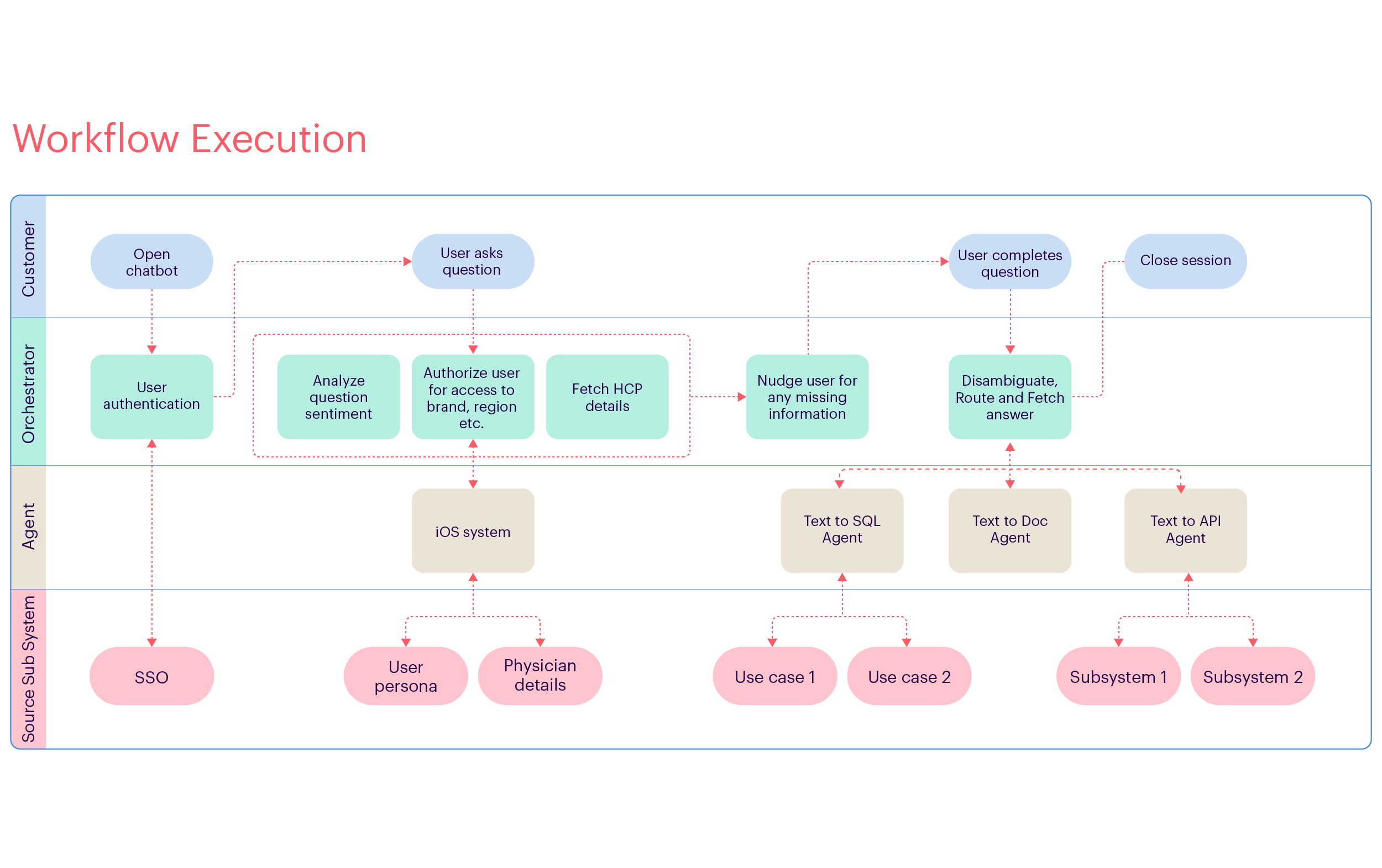
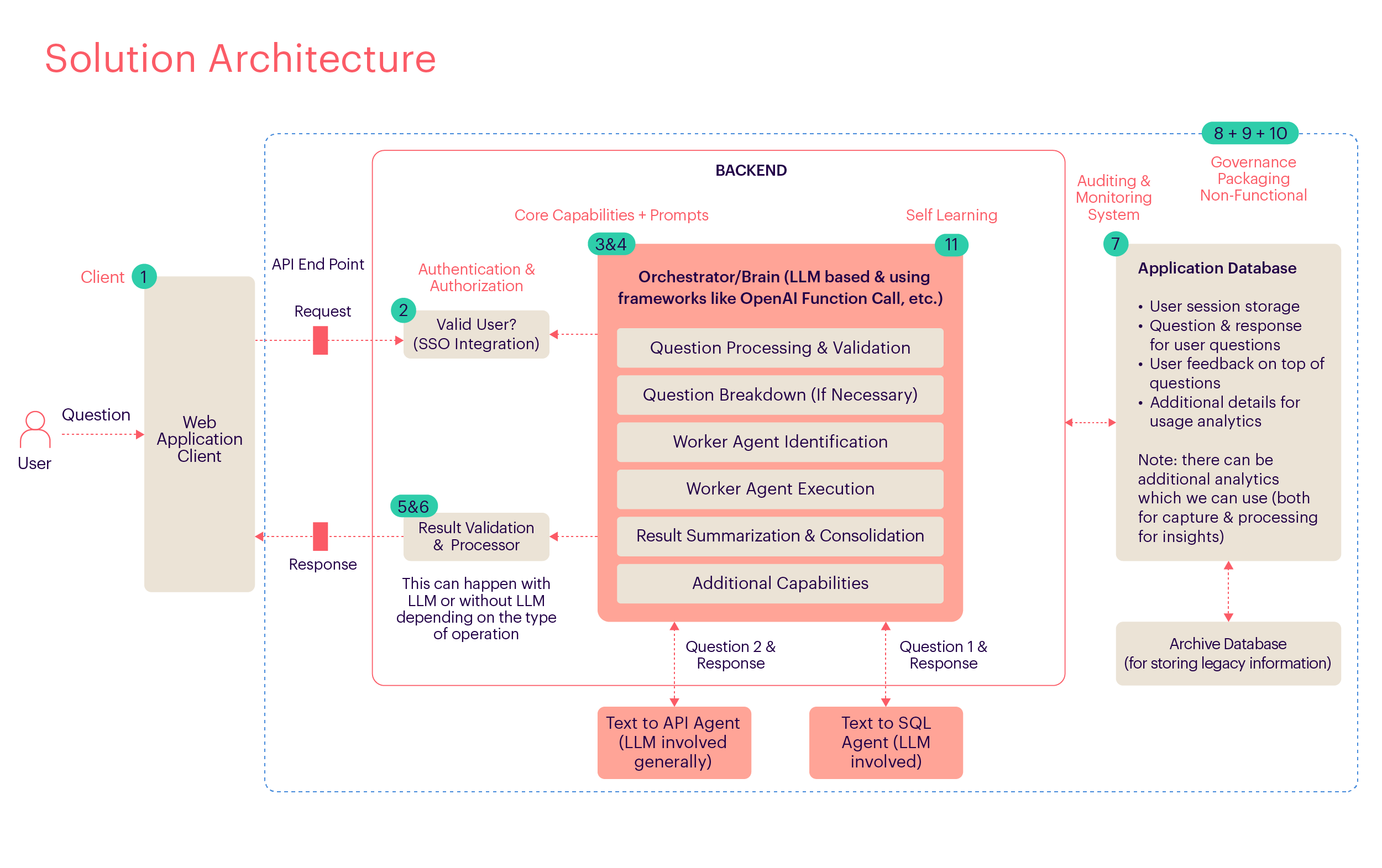
At its core, RepGPT functions as an ecosystem of intelligent agents orchestrated by a central “brain.”
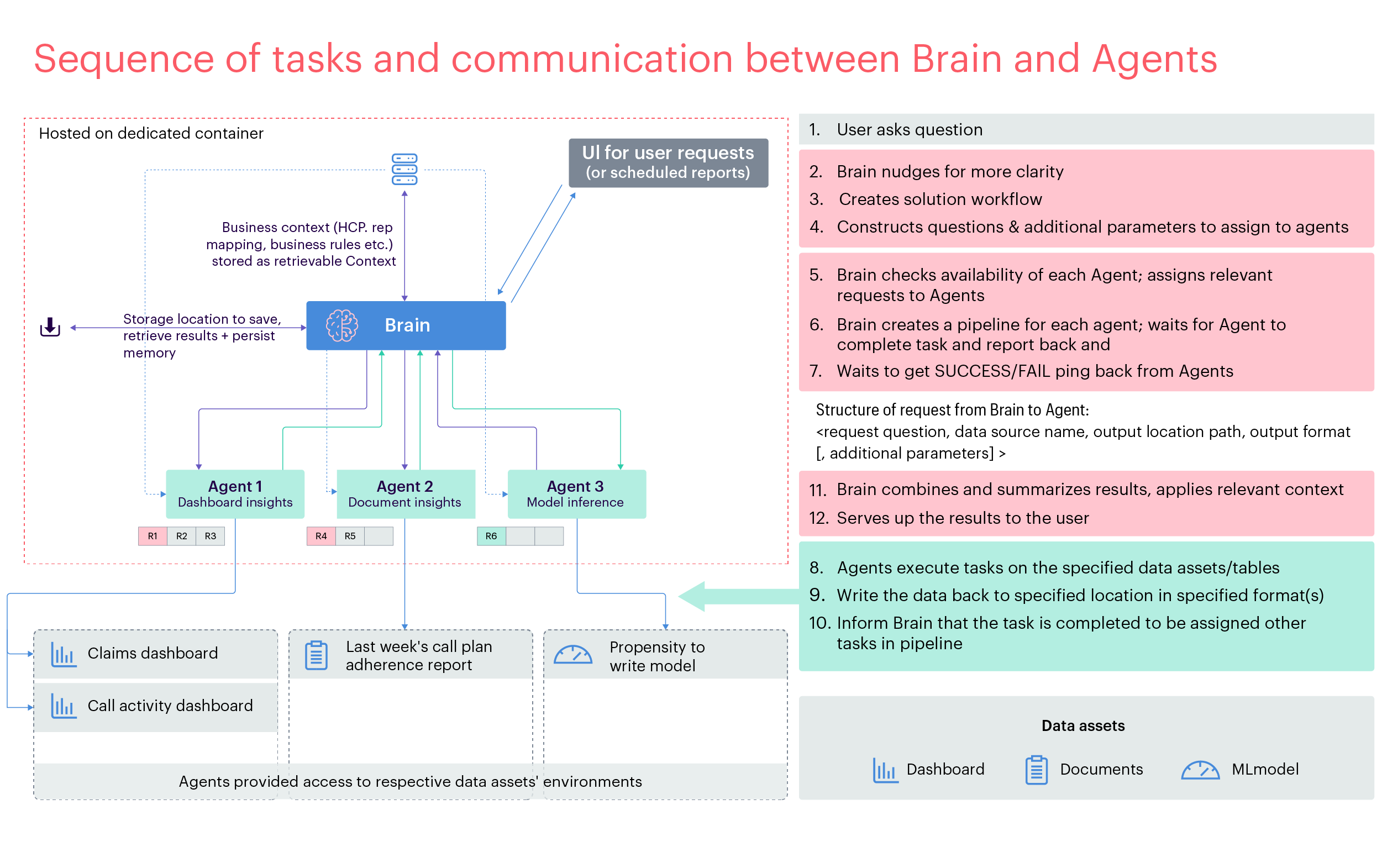
- The Disambiguation & Routing Agent (DRA): Acting as the system’s brain, the DRA interprets user queries—like, “Which KOLs should I engage with this week?”—and breaks them into smaller, actionable tasks. It determines the most suitable worker agents for each sub-task, coordinates their actions, and synthesizes their outputs into clear, actionable responses.
- Worker Agents (WA): These specialized agents perform targeted tasks such as querying databases, analyzing unstructured documents, and running predictive models. For instance:
a) The Text-to-SQL Agent extracts structured data efficiently.
b) The Document Retrieval Agent synthesizes information from reports.
c) The Model Inference Agent provides advanced analytics like patient segmentation or engagement scoring. - Infrastructure Layer: The glue binding it all together, this layer ensures real-time performance, secure communication, and scalability to handle large datasets and complex queries seamlessly.
Empowering Users Across Platforms
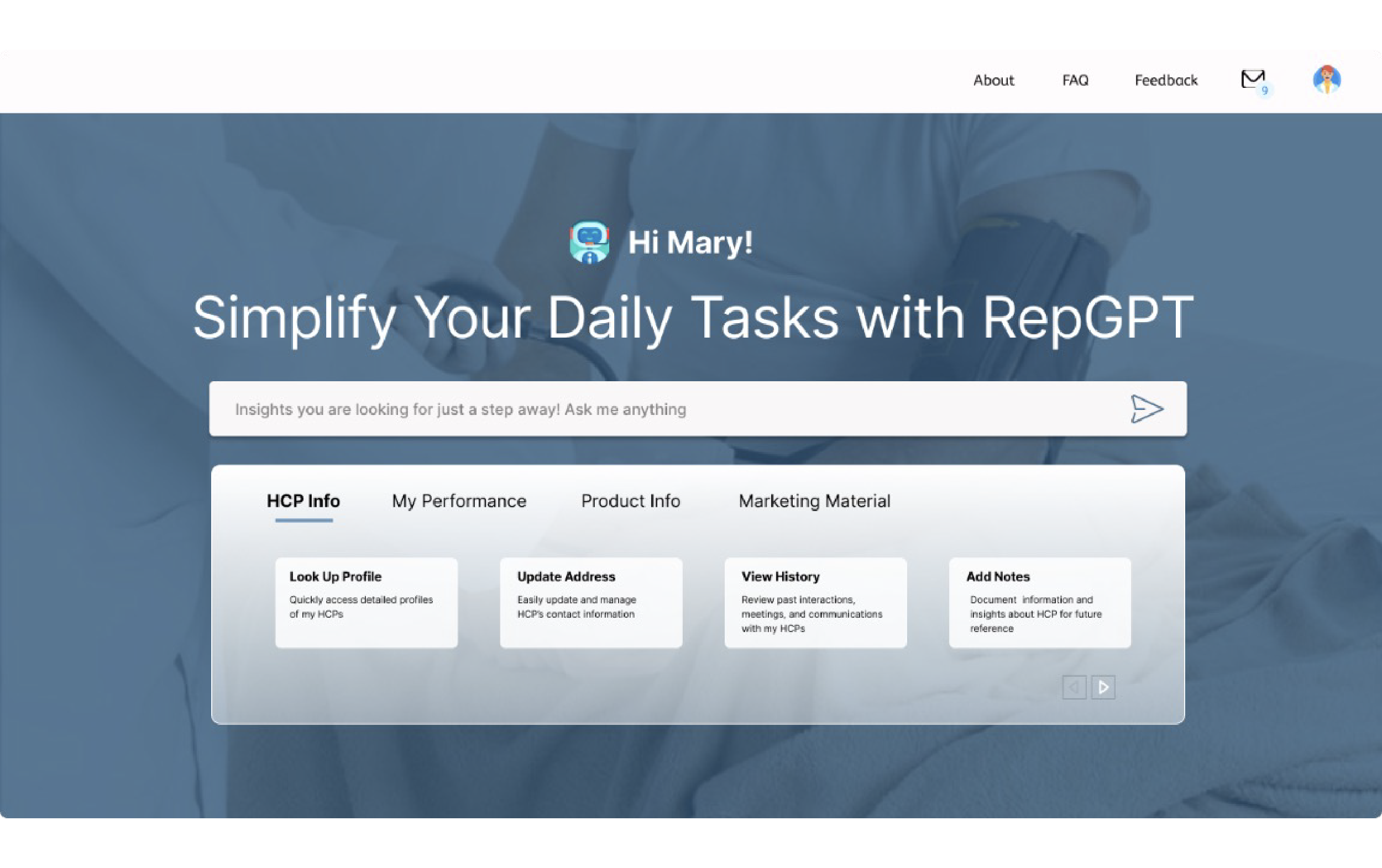
RepGPT provides a user-centric, multi-channel experience. Representatives interact with the platform through intuitive dashboards on web and mobile applications, enabling them to access HCP details, review engagement histories, and generate actionable insights.
The conversational chatbot interface offers real-time responses, synthesizing data from integrated systems like Veeva and iREP, ensuring representatives always have the most relevant information.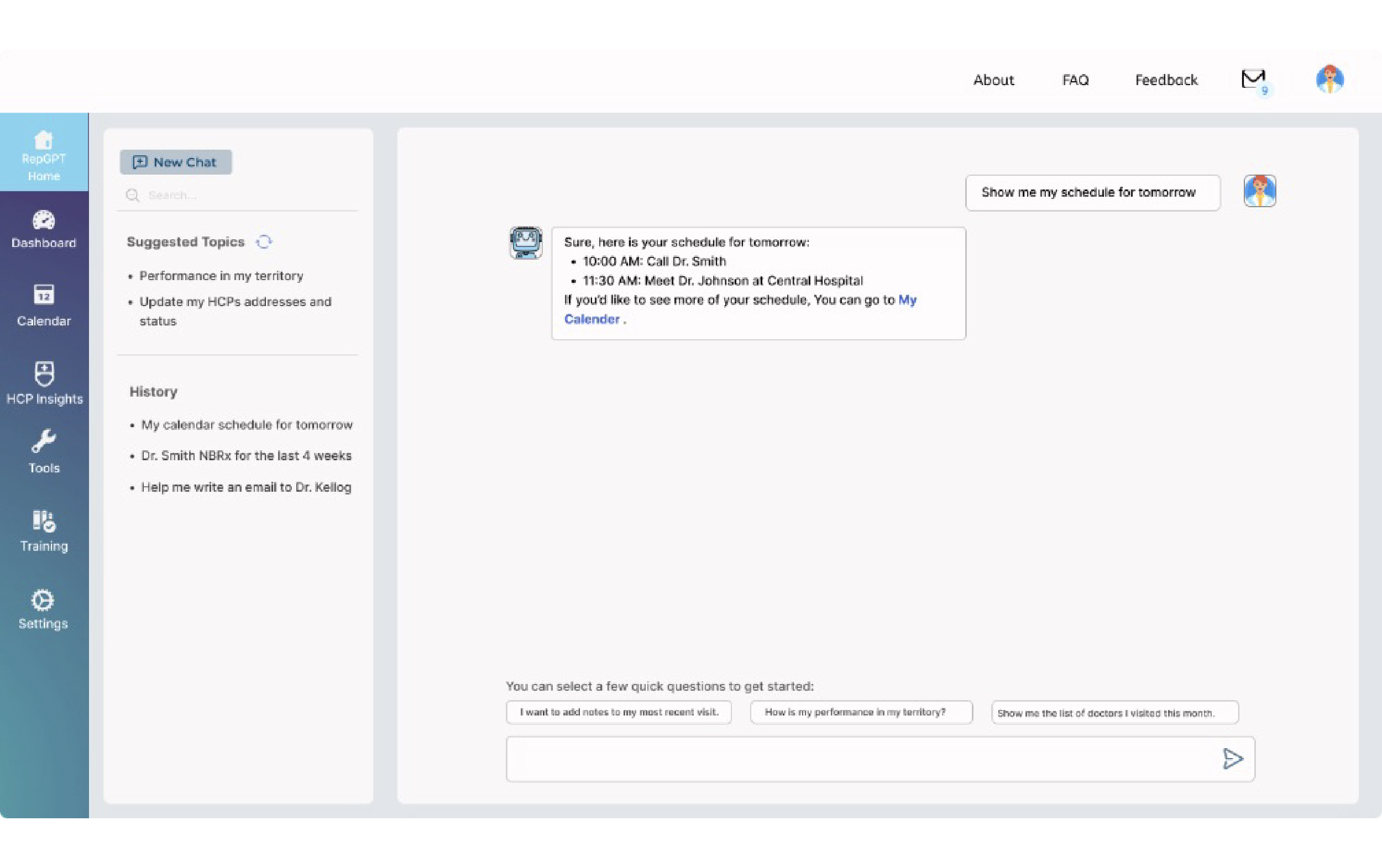

Customization lies at the heart of RepGPT. Insights and workflows are tailored based on the user’s role, brand focus, and regional context. Secure Single Sign-On (SSO) ensures access remains compliant and secure, further enhancing its reliability for enterprise use.
Transforming Daily Operations
RepGPT redefines workflows for both MSLs and sales representatives. Consider a Precision Medicine Liaison preparing for the week ahead. By posing a simple query—“Which hospitals and accounts should I prioritize next week?”—RepGPT delivers a data-backed, actionable plan. It integrates inputs like patient volume trends, clinical trial updates, and CRM activities, providing clear recommendations on where to focus and how to engage effectively.
Pre-call planning is another game-changing application. RepGPT analyzes call activity data, clinical insights, and market research to recommend the top 10 HCPs or hospitals to prioritize. It even suggests conversation starters or follow-up topics based on previous interactions, ensuring every engagement is meaningful and impactful.
For sales managers, RepGPT provides visibility into team performance, enabling better planning and decision-making. By automating routine tasks like documentation and summaries, it frees up time for strategic, high-value activities.
Databricks readiness:
- Metadata- and governance-driven ingestion accelerators leveraging Unity Catalog to manage sensitive HCP and clinical data with fine-grained access control, lineage, and compliance enforcement
- Agent Bricks– and Genie–enabled conversational intelligence accelerators to power RepGPT workflows, enabling natural-language querying, real-time reasoning, and explainable insight generation across governed structured and unstructured data in the Databricks Lakehouse
- Production-grade Databricks operational and FinOps accelerators to support always-on, low-latency AI interactions with predictable performance and controlled compute costs
Case Study: Elevating MSL and PML Effectiveness with RepGPT
Problem Statement
At a leading global pharmaceutical company, sales and medical engagement processes were constrained by fragmented access to information across teams and systems. Field representatives lacked a unified platform for scheduling, strategic planning, and insight generation, and relied heavily on manual workflows for meeting summaries, follow-ups, and knowledge discovery. To address these challenges, the organization sought a GenAI-powered disambiguation agent, RepGPT, built on the Databricks Lakehouse and Agent Bricks, to serve as an intelligent “brain” that could unify governed data access, automate workflows, and deliver real-time, actionable insights tailored to each representative’s role and objectives.
Solution
RepGPT in Action:
Powered by Databricks and orchestrated through Agent Bricks, RepGPT delivered a unified, conversational interface for MSLs, PMLs, and sales representatives by securely consolidating clinical, CRM, and market intelligence data governed through Unity Catalog. Using natural language queries, users could retrieve trial updates, review engagement histories, identify priority KOLs, and receive context-aware, prescriptive recommendations—without switching between systems.
Built on a Databricks-native multi-agent AI framework, RepGPT coordinated retrieval, reasoning, and synthesis across structured and unstructured data in real time, generating role-, therapy-, and market-specific insights with explainability and human-in-the-loop controls. By automating repetitive tasks and harmonizing disparate data sources on the Lakehouse, RepGPT evolved into a single system of intelligence for daily execution and strategic, compliant decision-making at scale.
Impact
The deployment of RepGPT drove significant, measurable results:
- 60% reduction in administrative preparation time, including meeting notes, trial references, and KOL identification
- 30% improvement in HCP engagement quality through personalized, insight-driven interactions
- 50% decrease in repetitive system tasks, freeing reps for higher-value activities
- 25% boost in overall sales rep productivity, enabling faster, more informed decision-making
- Accelerated drug adoption cycles, stronger cross-functional collaboration, and improved customer satisfaction through data-backed, real-time engagement support
Why RepGPT is a Game-Changer
RepGPT addresses three critical challenges in pharmaceutical sales and engagement:
- Information Silos: By integrating diverse data sources and orchestrating tasks, RepGPT delivers unified insights that were previously scattered.
- Repetitive Tasks: Automation reduces administrative overhead, allowing professionals to focus on strategy and relationships.
- Real-Time Support: With instant, data-driven recommendations, RepGPT ensures that every HCP interaction is productive and well-informed.
The result is a profound shift in how professionals operate. Meetings are better prepared, follow-ups are personalized, and decisions are driven by actionable insights. For organizations, this means improved sales performance, stronger HCP relationships, and faster drug adoption rates.
Building the Future of Connected Intelligence
RepGPT is more than a tool—it’s part of a broader vision for connected intelligence, where AI solutions integrate across roles and functions to streamline decision-making. Imagine a future where every stakeholder, from marketing teams to executives, has a personalized assistant powered by the RepGPT ecosystem.
As the framework evolves, its applications will extend into areas like regulatory compliance, patient engagement, and market analytics, further cementing its role as an indispensable ally in modern healthcare.
In an industry as dynamic as healthcare, RepGPT doesn’t just simplify tasks—it empowers professionals to deliver better outcomes. By combining advanced AI with deep domain expertise, it paves the way for smarter, more connected, and more impactful pharmaceutical engagements. With RepGPT leading the charge, the future of healthcare is not just intelligent—it’s revolutionary.
Leveraging Multi-Touch Attribution for Optimizing Pharmaceutical Content-Level Messaging