The way consumers discover brands has been undergoing a silent change that CPG enterprises have not budgeted for. For years, digital strategy for CPG brands relied on visibility to sell and grow. This meant ranking on search engines, winning the digital shelf on e-commerce platforms, and driving traffic to brand-owned or retailer-controlled channels. The investment was primarily in Search Engine Optimization (SEO).
Today, this model is not enough. Brands that aim to stay relevant need to shift to an emerging model that is not defined by search visibility, but visibility on AI surfaces. This is where Answer Engine Optimization (AEO) and Generative Engine Optimization (GEO) come into play. They determine whether a brand is surfaced and how it is represented when AI platforms generate answers to consumer queries. That shift is already underway.
From Browsing to AI-Advised Discovery
Today’s consumers want to be more informed about the products they choose. Purchase decisions are increasingly shaped by considerations such as ingredients, safety, ethics, sustainability, value, and suitability for specific needs. In many categories, consumers have moved from being passive followers of brands to active researchers seeking confidence before they buy.
As a result, the traditional model of browsing multiple links and comparing options manually is giving way to a new behavior pattern. Instead of searching “moisturizer for sensitive skin” on conventional search platforms, consumers are increasingly turning to AI surfaces for direct, curated guidance.
AI-powered engines such as ChatGPT, Google Gemini, and AI assistants embedded within ecommerce platforms such as Amazon Rufus no longer present generic lists of available products. They analyze product descriptions, reviews, claims, and contextual signals to generate structured recommendations with reasoning.
This shifts discovery from links to explore to answers to consume. It also compresses the decision funnel, as research, comparison, and recommendation increasingly happen within a single interaction.
The implication is not simply fewer clicks. It is a redefinition of where and how decisions are made. For brands, this makes product data quality, content structure, and accessibility to AI systems far more important than before. If AI platforms cannot easily interpret and trust the available signals, brands risk being excluded from the recommendation set and overtaken by competitors that are better understood by these systems.
Why This Matters for CPG Brands: From Visibility to Interpretability with AEO and GEO
AI is rapidly becoming the new gatekeeper of discovery. Because recommendations are inherently constrained, only a small set of brands will appear in the top suggestions presented to consumers. Those that do not adapt risk becoming invisible at the most critical moment of the purchase journey.
For CPG brands, the implications are immediate. A product may perform strongly on e-commerce platforms, supported by significant retail media investments, and still fail to appear in AI-generated recommendations. In such cases, the issue is not performance—it is absence.
This marks a shift from share of shelf to share of answer.
When a consumer asks, “What’s the best low-sugar snack for kids?” the AI system does not retrieve links; it synthesizes an answer. The brands that appear are not necessarily those with the highest traffic, but those most clearly understood within the context of the query.
This is where AEO and GEO matter. AEO ensures a brand is eligible to appear in direct answers, while GEO shapes how the brand is interpreted, positioned, and recommended. Success now depends less on content volume and more on semantic precision, contextual relevance, and AI-readable product data.
There is also a broader strategic shift underway. Just as SEO evolved from a niche skillset into a standardized capability, AEO and GEO will increasingly generate platform-specific tools and signals across AI surfaces. But optimizing within a single platform will not be enough.
Consumers move across multiple AI ecosystems such as search assistants, commerce platforms, and generative interfaces. A brand may be recommended on one surface and absent on another. Managing this through siloed agencies or isolated tactics creates fragmented visibility.
The real advantage will belong to brands that build a cross-platform view of AI discovery. This is where partners such as MathCo create value by consolidating signals across AI environments and helping brands optimize holistically.
For CPG leaders, the message is clear: success in the AI shelf era will not come from isolated wins, but from orchestrating visibility and recommendation strength across the full AI ecosystem.
The Emerging Challenges in AI-Driven Commerce
While the opportunity is significant, the operating environment is fundamentally different and more complex.
Limited Visibility into Brand Presence and Perception Across AI Platforms: Brands often lack clarity on whether they appear in AI responses and where they don’t. The brand nuance is often lost in concise AI summaries.
Lack of Transparency into Algorithmic Recommendation Drivers: There is minimal visibility into why certain brands are recommended over others and how that can be changed.
Incomplete Structuring of Product Intent for AI Interpretability: Rich positioning is compressed into one or two lines. For instance, an AI system may describe a product simply as “good for babies,” while the intended positioning is “clinically tested protection for ultra-sensitive newborn skin.”
Absence of Standard Metrics for AI Visibility and Recommendation Share: There is no established equivalent of search rankings or impression share. Today, the data as to why certain products rank better over the other does not exist.
Reduced Control Over the Journey: AI collapses the traditional funnel, limiting opportunities for brand-led storytelling and persuasion.
Another critical challenge in the AI-driven landscape is understanding the queries consumers are asking on the AI surfaces. These are critical determiners for a brand to steal the recommendation spotlight. Unlike traditional search, there is no data readily available for brands to determine what is working and what isn’t. Enterprises often do not know how their brand is being represented, where they are missing, or why competitors are being recommended instead.
AI Commerce Intelligence, Powered by MathCo
MathCo’s AI Commerce Intelligence framework helps CPG enterprises solve this landscape seamlessly and influence AI-driven discovery. Our approach ensures brands move beyond visibility to win algorithmic preference and the digital shelf. The base of this is identifying the key queries consumers often ask. Question structuring holds the key to this.
At MathCo, question structuring is not a surface-level keyword exercise. It’s a rigorous, insight-led approach grounded in how consumers actually think, speak, and decide. We anchor our models in real, high-volume search intent, layer in voice-of-consumer signals from reviews and forums, and systematically identify the attributes that truly drive decisions. These inputs are then expanded using AI into natural, high-relevance question variations, with strict filtering to ensure realism, not noise. Finally, we map them across the full consumer journey, from discovery to purchase, so brands don’t just capture interest, but influence decisions. The result is a high-confidence question ecosystem built on data, not assumptions.
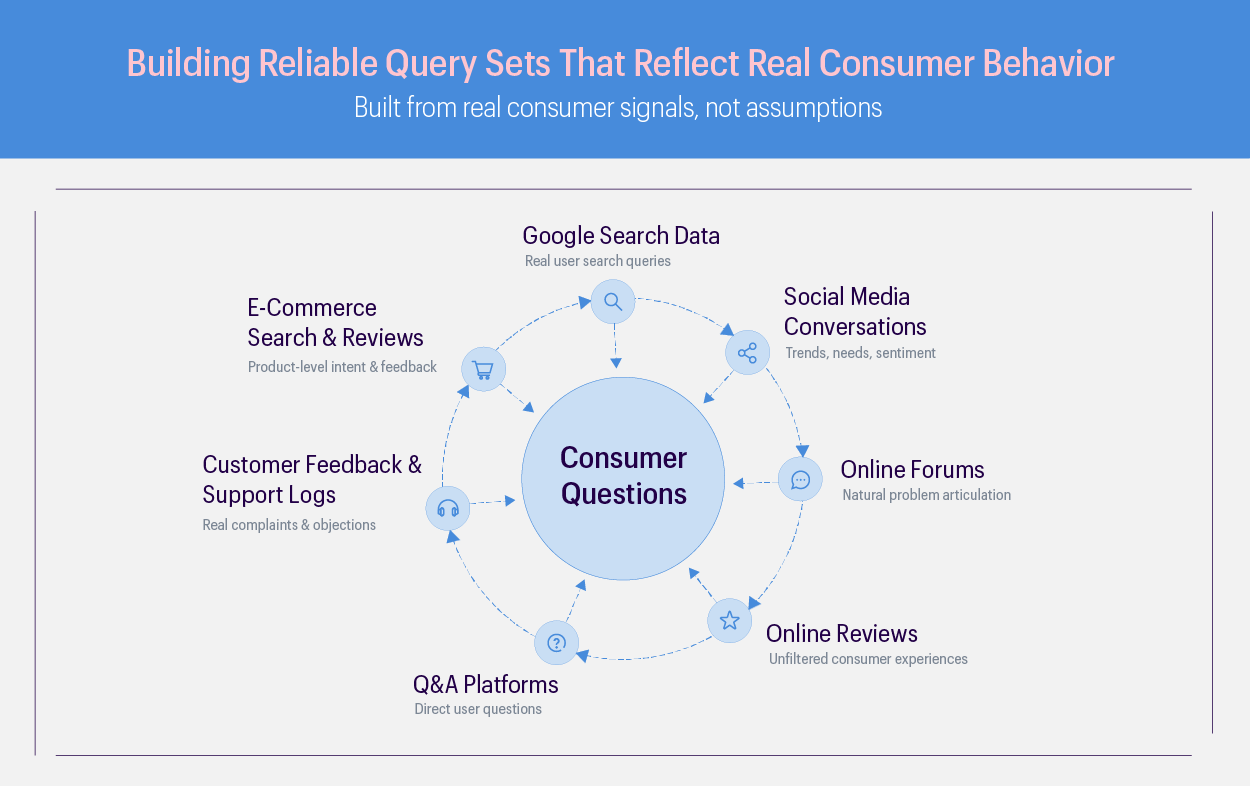
Once the foundation is laid, our workflow leverages AI agents to analyze responses and identify how brands and products are ranked, described, or excluded. This creates a continuous feedback loop, enabling brands to move from assumption-driven strategies to evidence-based optimization.
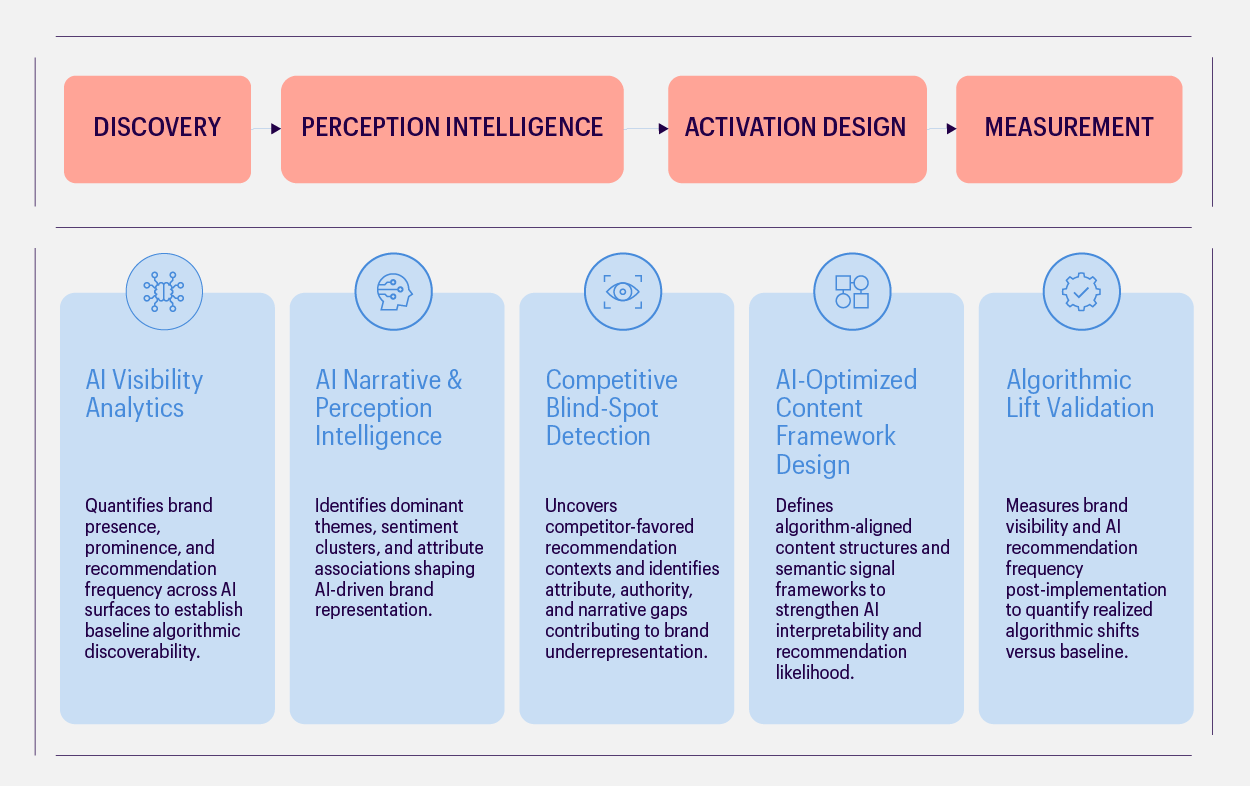
AI Visibility Analytics
What it does:
Measures how often the brand appears in AI-generated responses and identifies the queries where it is surfaced or absent.
AI Narrative & Perception Intelligence
What it does: + what are the key questions answered:
Analyzes how AI systems interpret and describe your brand, extracting key attributes and themes that define its positioning in AI-generated responses.
Competitive Blind Spot
What it does:
Identifies gaps and opportunities based on responses generated from queries on the AI platforms, where competitors are recommended while your brand is missing, and uncovers the attributes driving those recommendations.
AI-Optimized Content Framework Design
What it does:
Translates insights into structured content and data improvements aligned with how AI systems interpret and prioritize product attributes.
Algorithmic Lift Validation
What it does:
Once the previous 4 frameworks are deployed, we measure brand visibility and AI recommendation frequency to quantify how the performance has enhanced post-implementation.
Delivering Impact, The MathCo Way
A global CPG leader was increasingly aware that AI platforms were influencing consumer discovery and purchase decisions. They lacked any clear visibility into how their brands were performing in AI-generated responses. Some of the challenges that further blindsided them include:
- Limited understanding of gaps vs. competitors across key attributes and themes
- No data-backed recommendations to guide actions or demonstrate measurable impact
MathCo partnered with the client to address this, starting with a priority brand on a specific AI surface (ChatGPT) identified by the client, and delivered measurable outcomes within a 4-week sprint. Some of the steps we took to implement this include:
- Built a structured, consumer-intent–led query framework using real-world inputs (FAQs, ecommerce Q&A, category discussions) and executed it on ChatGPT to assess brand presence
- Developed perception intelligence to identify positive and negative themes associated with the brand in AI responses
- Conducted competitive positioning analysis using keyword frequency and entity-level mapping to uncover strengths and gaps
- Translated insights into targeted, data-backed recommendations across content, messaging, and attribute reinforcement strategies
Impact:
- Achieved full visibility across priority consumer journeys on ChatGPT within 4 weeks
- Enabled data-backed optimization with clear, actionable recommendations
- Delivered up to 3x improvement in recommendation strength through better-aligned, AI-interpretable content signals
Stay Relevant with AEO and GEO
It is critical for enterprises to establish frameworks for AEO and GEO, but in the rush to gain traction, many risk falling behind through a misaligned approach. A common mistake is treating AEO and GEO as an extension of SEO. Optimizing keywords and rankings does not automatically translate to influencing AI-generated recommendations.
At the same time, fragmented and inconsistent product and brand data limit how effectively AI systems can interpret and surface brands. Over-reliance on keywords instead of intent and context, combined with static content strategies in a dynamic AI ecosystem, only widens this gap.
The brands gaining advantage today are those using AEO and GEO not only to identify gaps in visibility and recommendation performance, but to act on those insights quickly. The next frontier is connecting these intelligence layers to creative ad generation agents that can continuously refine messaging, product descriptions, and campaign assets based on emerging AI signals.
This is where MathCo is helping create a new operating model: an automated system of continuous iteration that enables brands to improve visibility, capture missed opportunities, and adapt in real time across AI surfaces. We will be sharing more on this evolving model soon.
The brands that move decisively will shape how their categories are defined in AI-driven discovery. They will secure early visibility, reduce dependence on paid media, and build trust at the moment decisions are made.
The question is no longer, “Are you ranking?”
It is, “Are you being recommended?”