Many believe artificial intelligence functions as an entirely autonomous engine, capable of erasing human effort across the business landscape. In reality, strategic automation requires a deep cognitive partnership. While machines seamlessly absorb the middle territory of structural execution and data decomposition, the ends of the problem-solving cycle remain stubbornly human. True operational success still requires noticing weak signals, framing complex goals, judging subtle context, and accepting ultimate legal and institutional accountability.
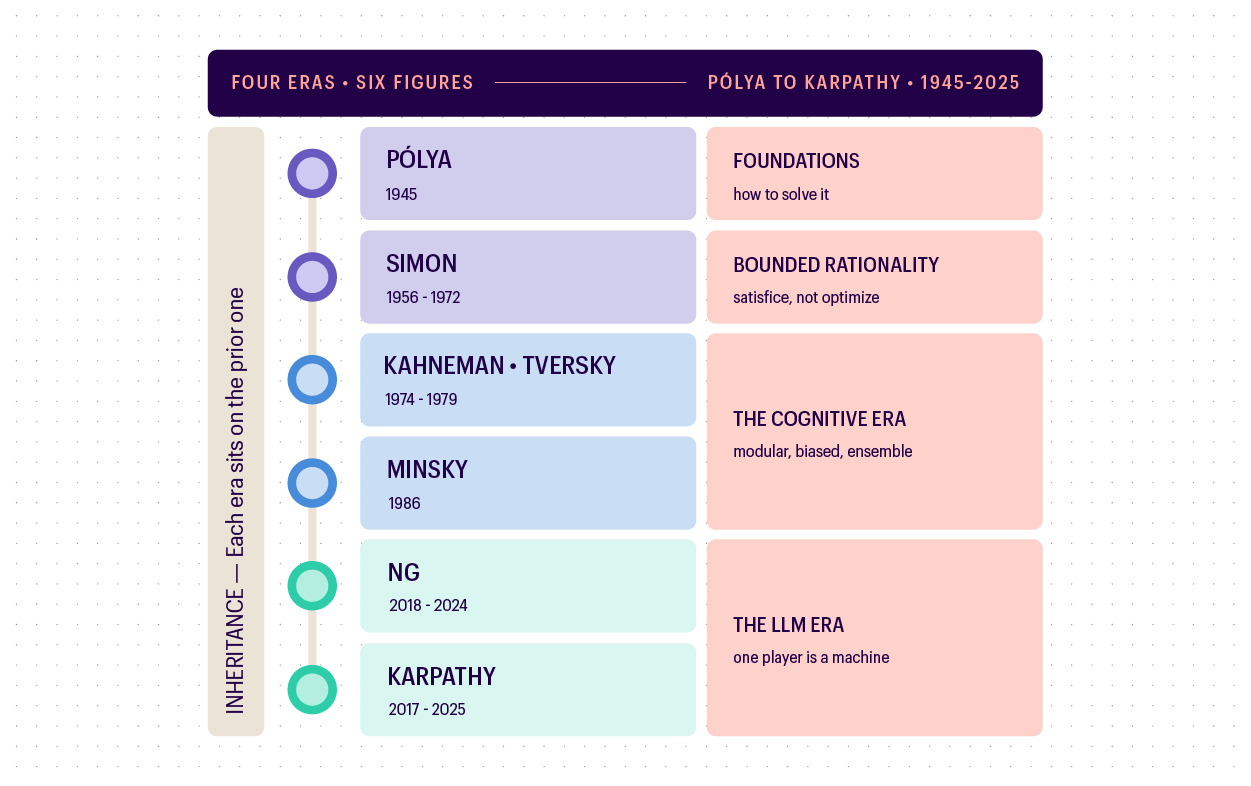
This human-machine architecture rests on an intellectual lineage of six figures across four distinct eras. It begins with the foundations of Pólya’s problem-solving steps and Simon’s concept of bounded rationality, explaining how minds “satisfice” rather than optimize. Next, the cognitive era of Kahneman, Tversky, and Minsky maps out the modular, biased nature of human judgment. Finally, contemporary voices like Andrew Ng and Andrej Karpathy define the modern LLM era, illustrating how automated workflows operate when one player in the loop is a machine.
Problem Space and Search for Optimal Path
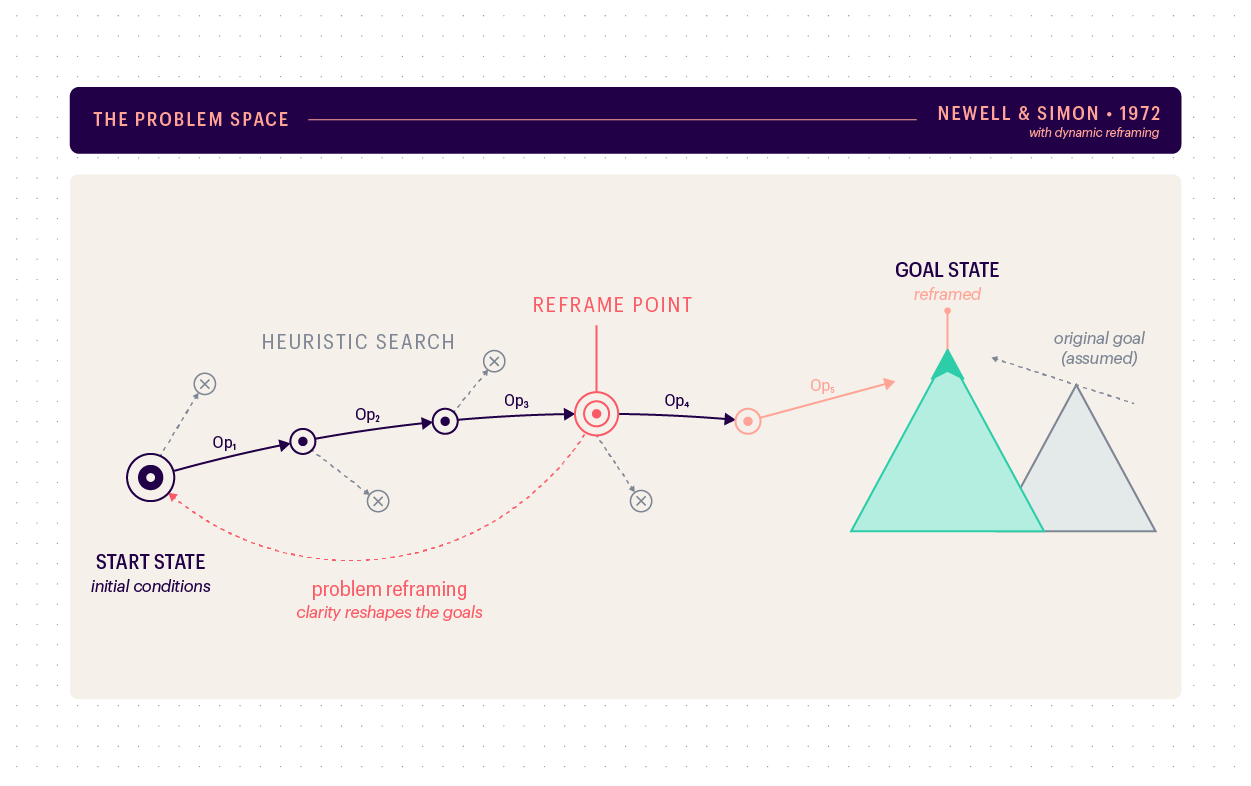
Herbert Simon defined problem-solving as a search through the problem space. Any problem space maps out with a clear start state, a target goal state, and the sequential operators needed to move between them. Every challenge can be visualized as a geometric landscape containing a defined start state, a target goal state, and a series of sequential operators required to navigate the distance between them. The efficiency of any solver depends on their capacity to chart an accurate path through this landscape without exhaustively searching for every dead end.
Enterprise challenges are distributed across a spectrum of three structural types: well-defined, partially defined, and ill-defined.
- Well-defined problems feature unambiguous initial conditions, crystal-clear targets, and a known set of operators. In this territory, large language models deliver outstanding performance, frequently matching or exceeding human speed, accuracy, and operational throughput.
- Partially defined problems introduce minor ambiguities, where the goal is clear, but certain analytical paths remain hidden, requiring human checkpoints to guide the machine.
- The real strategic risk emerges within ill-defined problems. In these scenarios, the goal state itself is unknown and must be actively constructed through discovery. This is where unmanaged artificial intelligence consistently falters. When left to navigate an ill-defined space without human intervention, an LLM tends to over-specify constraints, generate false certainties, and drift away from the underlying business reality. Mapping an ill-defined space requires a capacity to pause, evaluate contextual shifts, and dynamically alter the trajectory based on real-world constraints that do not exist inside the model’s training data.
The following diagram maps the journey from a start state to a goal state via intermediate operators, highlighting abandoned dead ends along the way. Crucially, a reframing arc bends the path backward when the apparent goal proves incorrect and requires adjustment.
Defining the Reframing Arc
Most major enterprise analytics projects do not fail during the final execution phase; they fail because of a flawed initial frame. Teams routinely choose a problem definition early in a business cycle, accelerate deployment, and discover far too late that they were solving for the wrong business metric. The organizational cost of these late-stage corrections is super-linear, resulting in massive re-work, wasted compute, and alignment failure.
True strategic clarity is not a static milestone achieved at the start of a project; it is a dynamic quality developed during the solving process itself. As intermediate operators are applied to the problem space, the landscape changes, forcing the solver to bend the path back via a reframing arc. This capacity to pivot requires balancing political costs, updating vocabularies, and retiring legacy models across multiple functional teams.
In an AI-augmented environment, the primary threat to this process is premature decomposition. Because large language models are engineered to instantly structure, categorize, and break down incoming prompts, they move toward execution at a speed that forecloses the opportunity to reframe. They accept the user’s initial prompt as an absolute truth, building elaborate, highly polished execution paths on top of a broken foundational assumption. Halting premature decomposition requires deliberate operational friction, forcing teams to challenge their definitions before launching automated workflows.
What Are the End Keystones?
The foundational rule of modern enterprise architecture is a strict division of cognitive labor: keep humans at the frontiers and machines in the middle. The convergent middle of the problem-solving cycle involves atomizing instructions, executing parallel tasks, and running routine validation loops. This is the exact domain where a computational scale generates a massive return on investment, allowing models to take over the heavy lifting of drafting, coding, and information retrieval.
The two ends of the loop must remain strictly human domains because they require capabilities a machine cannot possess. The front end requires noticing and defining. Noticing requires being in the world, picking up weak signals from context, corporate politics, and tacit operational knowledge. Defining requires imposing human values, balancing conflicting stakeholder motivations, and choosing exactly what success means.
The back end requires judging and owning. Judging fit demands a deep intuition to evaluate whether a polished, statistically probable machine output actually satisfies the original strategic intent. Owning requires accepting institutional accountability for the risks and outcomes of the decision. While an LLM can provide productive inputs at either frontier, such as running stakeholder simulations or identifying logical inconsistencies, it cannot own the outcome. Accountability is a legal and ethical contract between a person and an institution; it cannot be transferred to a software component.
The Human-LLM Loop
The engine of modern analytical productivity is the iterative interaction that takes place between human framing and machine decomposition. This human-LLM loop does not operate as a single transaction, but as a continuous cycle of inputs and adjustments. The process initiates when a professional translates a vague operational intuition into a text prompt, which the model instantly processes to generate an explicit decomposition artifact.
This artifact should never be treated as a definitive answer. Instead, it functions as a conceptual prototype of the problem space itself. When a human reads this explicit structure, it triggers an immediate reaction, often starting with the phrase, “that is not quite what I meant.” This negative reaction is highly valuable because it externalizes implicit knowledge that humans cannot access directly. The machine’s structured output serves as a mirror, forcing the user to identify hidden assumptions, clarify ambiguous goals, and feed a refined frame back into the system.
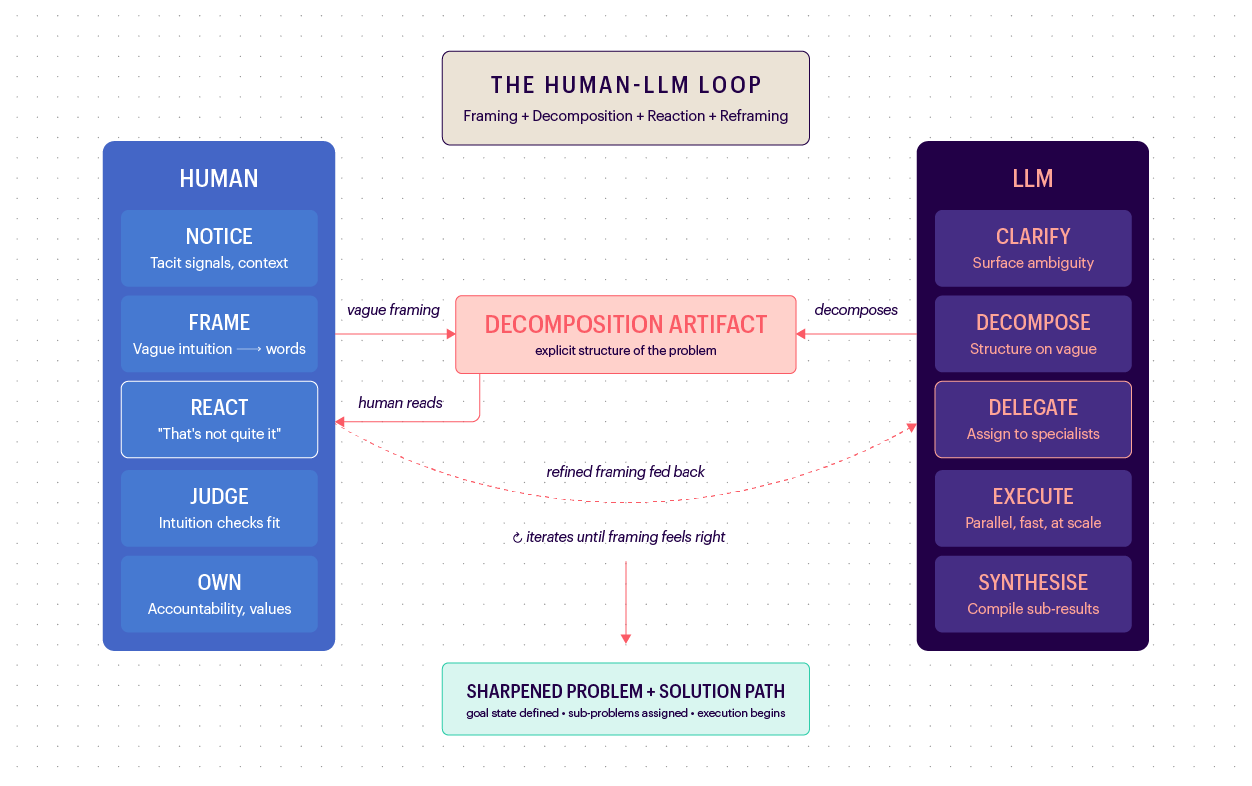
A productive cycle generally stabilizes between three and seven iterations. Single-round completions are a clear sign of premature closure, where a user uncritically accepts the first coherent draft the system produces. Conversely, loops that exceed fifteen rounds indicate a breakdown in coordination, where verification debt mounts because a stable strategic frame was never locked in. Managing this loop requires monitoring the trajectory of feedback to ensure each turn delivers a genuine material refinement rather than a superficial rephrasing.
The Four Ways This Loop Breaks
When the geometry of the human-LLM loop is left unmanaged, it breaks down along predictable cognitive and economic lines. These vulnerabilities arrange themselves into a clean diagnostic framework that allows leaders to identify hidden risks in their operations.
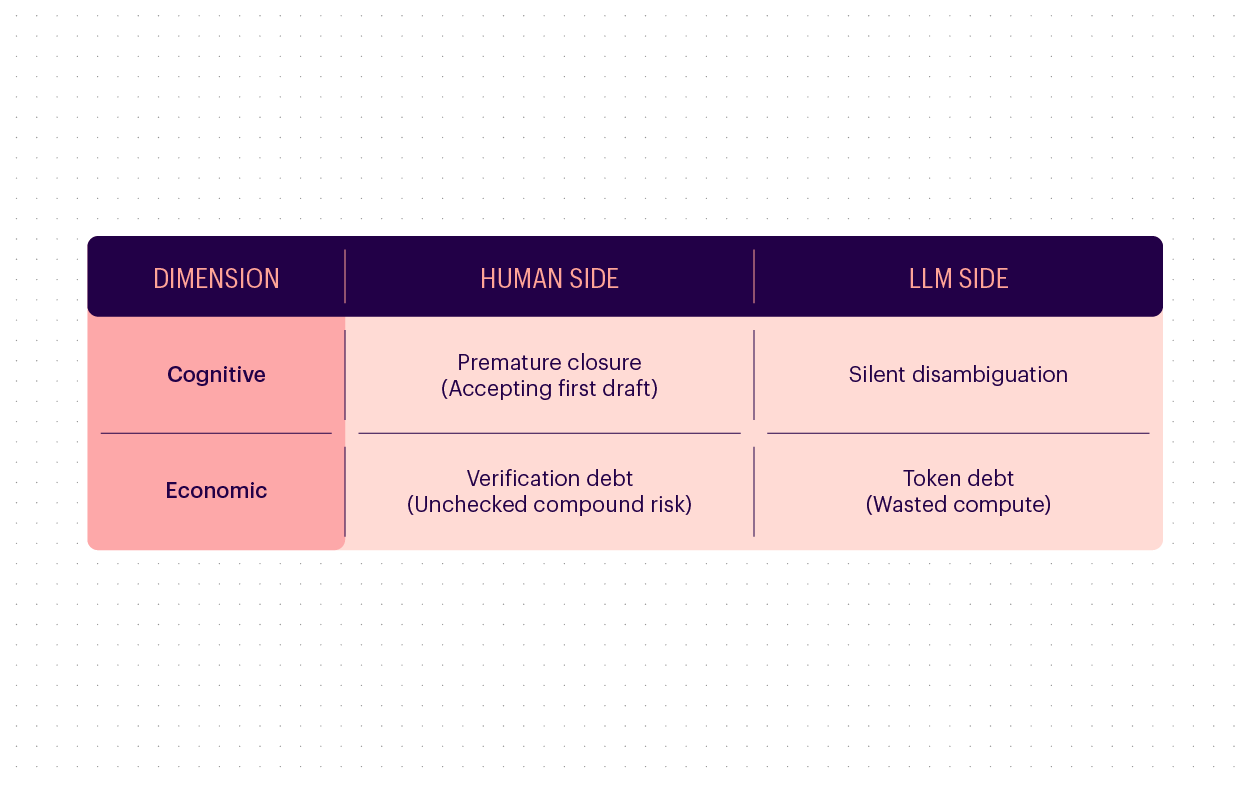
There are two cognitive failures, one on each side of the loop, and two economic failures, also one on each side. Together, they form a simple two-by-two framework, a practical diagnostic tool for identifying when a human-AI loop is beginning to break down.
These four failure modes rarely occur in isolation. Silent disambiguation fuels verification debt because unresolved ambiguity shifts the burden of interpretation to the human reviewer, even as the time available to verify each output continues to shrink. Token debt, in turn, often conceals silent disambiguation. Lengthy reasoning chains create the appearance of rigor, reducing human vigilance and making it easier for hidden assumptions to go unnoticed.
Verification debt and token debt are the two unit economics levers of the loop. When verification effort is minimized while token consumption continues to rise, the system enters the characteristic failure mode of “let it run autonomously” deployments, where costs compound, oversight erodes, and confidence increasingly outpaces reliability.
The Human-AI Operating Model
A resilient corporate workflow requires an asymmetric division of labor across the six key phases of problem solving. Organizations must explicitly map out who owns each step to prevent automation from erasing essential human checks.
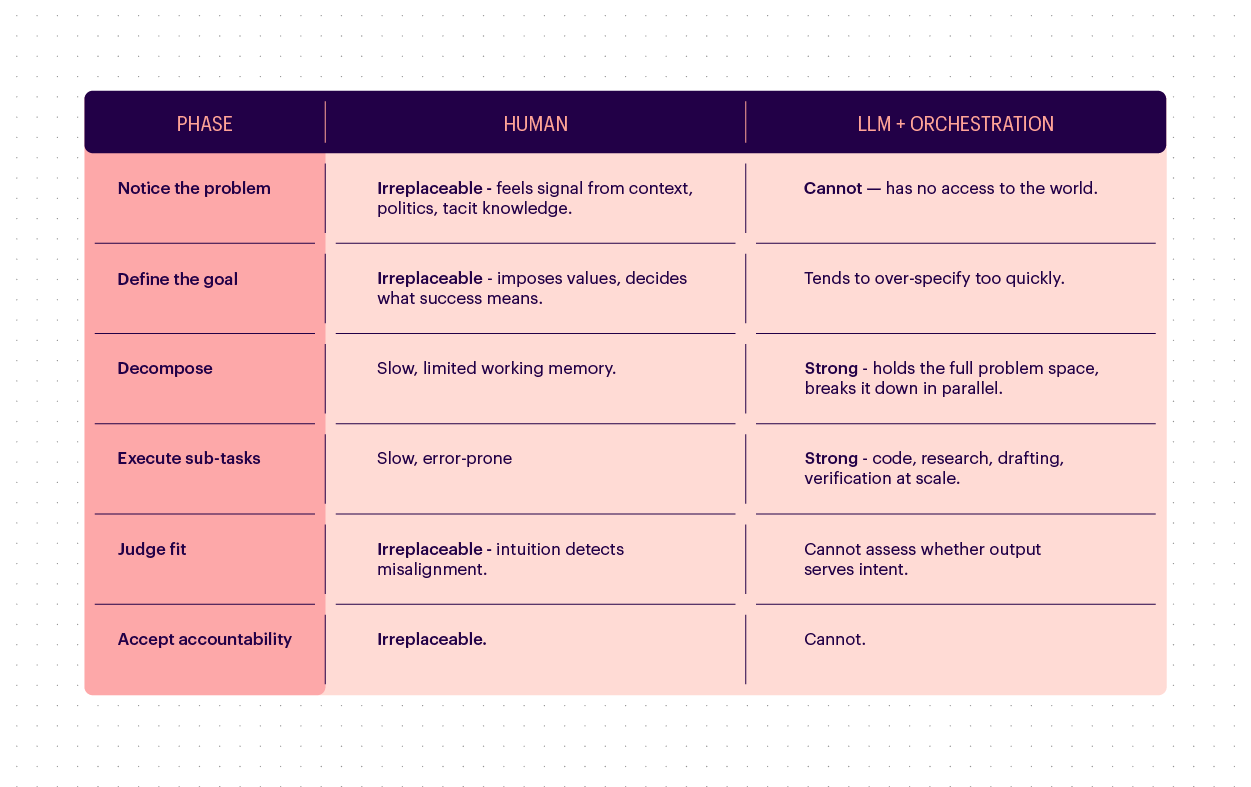
The asymmetry between irreplaceable inputs (which prevent failure) and strong inputs (which merely increase speed) determines workflow success. True geometry places humans at the ends of the loop (defining, judging, and accepting) while LLMs absorb the middle (decomposing and executing).
At scale, this workflow becomes an enterprise matrix. Front-line teams and executives handle problem definition, while governance and leadership manage final judgment. Enterprise architecture bridges this matrix with a modular AI setup, ensuring system design mirrors human boundaries and machine capabilities.
The Unit Economics Behind Scalable Enterprise AI
Every single iteration within the human-LLM loop incurs a dual financial cost that corporate leadership must actively manage. The first is the human-side cost, calculated as the verification time spent by senior professionals auditing machine outputs. The second is the model-side cost, measured by computational token consumption across input context windows and output reasoning chains.
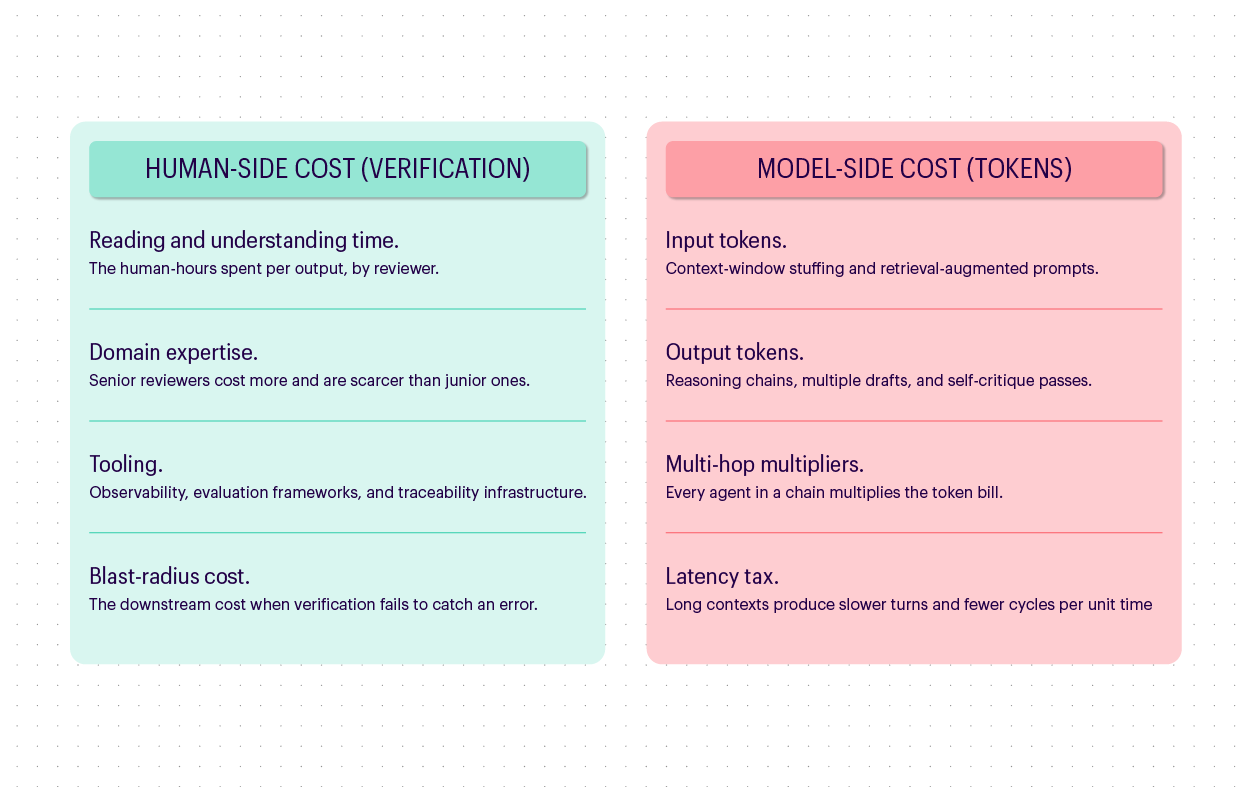
Today’s default deployment strategy sits in an inefficient quadrant: low token spend combined with heavy human verification. Companies deploy basic, unoptimized prompts that generate low-quality text, forcing highly compensated senior executives to spend hours reviewing and fixing the work. This approach fails to achieve true scalability because human attention remains the binding operational constraint.
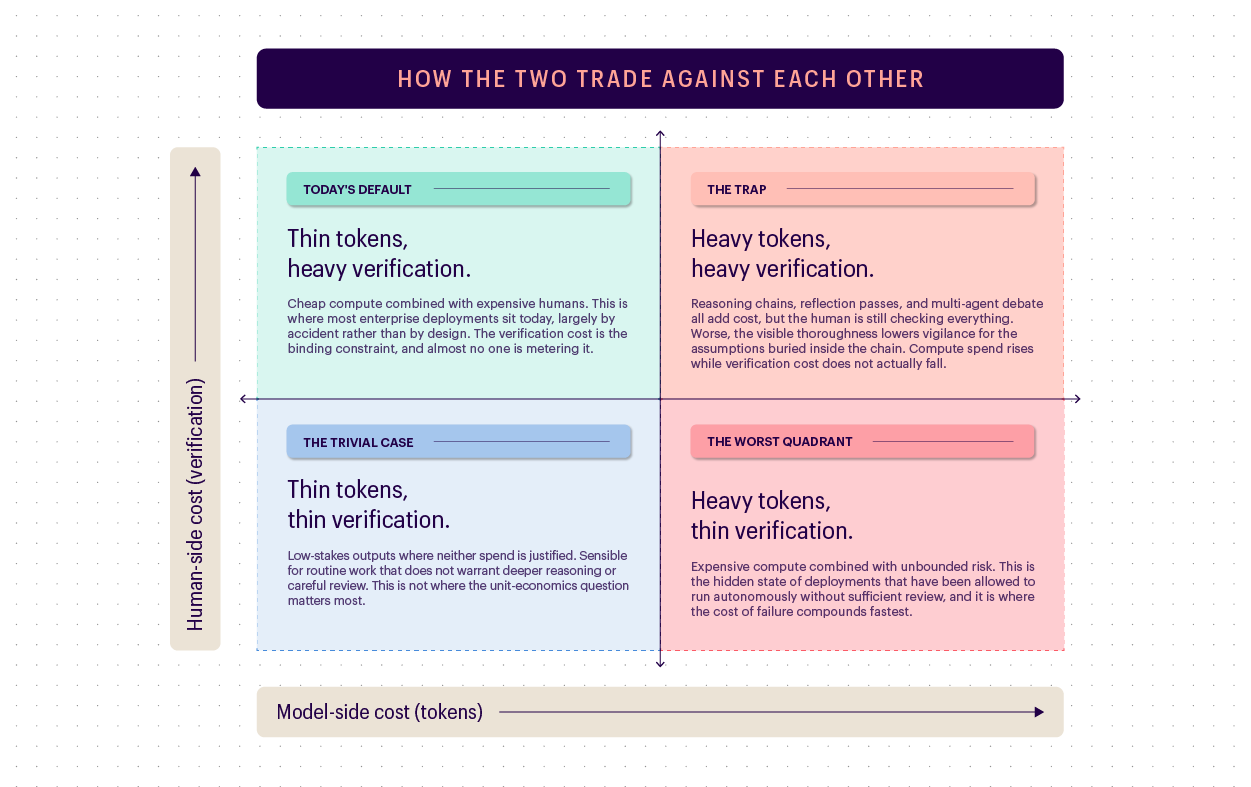
The target state for a mature enterprise is a deliberate shift toward higher token efficiency: spending computational budget intentionally on advanced reasoning patterns to buy down expensive human verification hours. While raw token costs fall exponentially year over year due to infrastructure improvements, the cost of senior human attention continues to rise. Strategic roadmaps must prioritize building tooling that simplifies the inspection process for human reviewers, leveraging compute to protect the organization’s scarcest resource.
How the Boundary Will Continue to Shift
The following forward-looking views represent our latest thinking rather than a settled position. Each of the three claims has consequences for how an organization should plan, hire, and build.
Claim 1: The Boundary Moves on Execution, Stays Fixed on Judgment
AI systems are increasingly taking over routine analytical work, code completion, and summary writing. However, tasks requiring human values (deciding what success means, for whom, and at what cost) remain stubbornly human. The gap between execution and judgment is widening, yet many assume AI will eventually do both, even though they are fundamentally different kinds of work.
Claim 2: The Structure of the Loop Is Stable, but The Geometry Changes
As AI capabilities improve, the sequence of framing, decomposing, reacting, and reframing stays the same. Only the cost of each phase changes. As models improve, decomposition and execution get cheaper, token costs fall, and verification can be sampled more aggressively. The ratio between the phase shifts, but the underlying structure does not disappear.
Claim 3: High-Impact Roles Are at the End
As AI makes the middle of the workflow faster and less expensive, the greatest value shifts to Notice, Frame, Judge, and Accept. This is not a temporary phase on the path to full automation. It is the new operating model.
Organizations should hire, develop, and reward people for these high-value responsibilities while recognizing that routine work in the middle of the workflow is being automated far more quickly than many leaders realize. At enterprise scale, the constraints of individual AI models, such as hallucinations, limited transparency, and the need for human verification, become organizational challenges. Auditability, traceability, and governance evolve from technical considerations into strategic requirements, making model risk management, vendor lock-in, and talent governance essential. Rather than eliminating the limits of human decision-making, AI reshapes how organizations manage and work within those limits.
Putting the Framework to Work
To operationalize this cognitive architecture, leadership teams must execute five pragmatic structural moves within their organizations:
- Shift attention to the ends: Reallocate time and senior presence away from mid-level production and concentrate it heavily on initial framing and final output validation.
- Expose hidden assumptions: Configure internal AI systems to produce an explicit list of disambiguation choices and assumptions before a human accepts a decomposition artifact.
- Enforce loop minimums: Build mandatory friction into workflow applications, requiring at least one explicit human reaction and refinement round before a project can progress.
- Budget verification dynamically: Track manual audit hours per project phase, sampling verification intensity in direct proportion to the blast radius of a potential error.
- Meter token return on investment: Monitor the cost-to-quality ratio of complex agent chains to ensure multi-hop reasoning patterns deliver a genuine reduction in human review time.

Anuj Krishna
Cofounder and President - Technology & GrowthAnuj Krishna is a seasoned leader with nearly two decades of experience in crafting and implementing analytics, data science, and engineering projects for prominent global enterprises spanning various industries that unlock the full potential of organizational data. Anuj has played a vital role in defining processes and standards for analytical problem-solving, now widely adopted by leading Fortune 500 enterprises. He was engaged in developing MathCo's proprietary AI-powered platform, NucliOS, showcasing his commitment to innovation.