Scaling AI enterprise-wide has become a strategic priority across industries. Organizations are investing heavily in AI, moving beyond experimentation and embedding it into core business functions to unlock measurable business value. AI initiatives have now secured executive attention and are increasingly central to enterprise transformation agendas.
Despite this momentum, many enterprises still struggle to scale AI beyond isolated use cases. While pilots show promise, these gains rarely translate into enterprise-wide impact. AI remains fragmented across teams, systems, and workflows, limiting sustained business value.
This creates a central tension for enterprise leaders: AI is working in parts of the organization, but not consistently across the whole.
If capabilities are stronger than ever, investment continues to grow, and adoption is accelerating, why does enterprise-scale value remain so difficult to achieve?
What the Data Reveals About the Real AI Bottleneck
MathCo partnered with HFS Research to survey more than 100 senior AI leaders across CPG, Retail, Pharma, Manufacturing, and High-Tech to explore what it takes to unlock AI value across the enterprise. Within the findings, a consistent set of constraints emerged that help explain why many organizations continue to struggle with scaling AI.
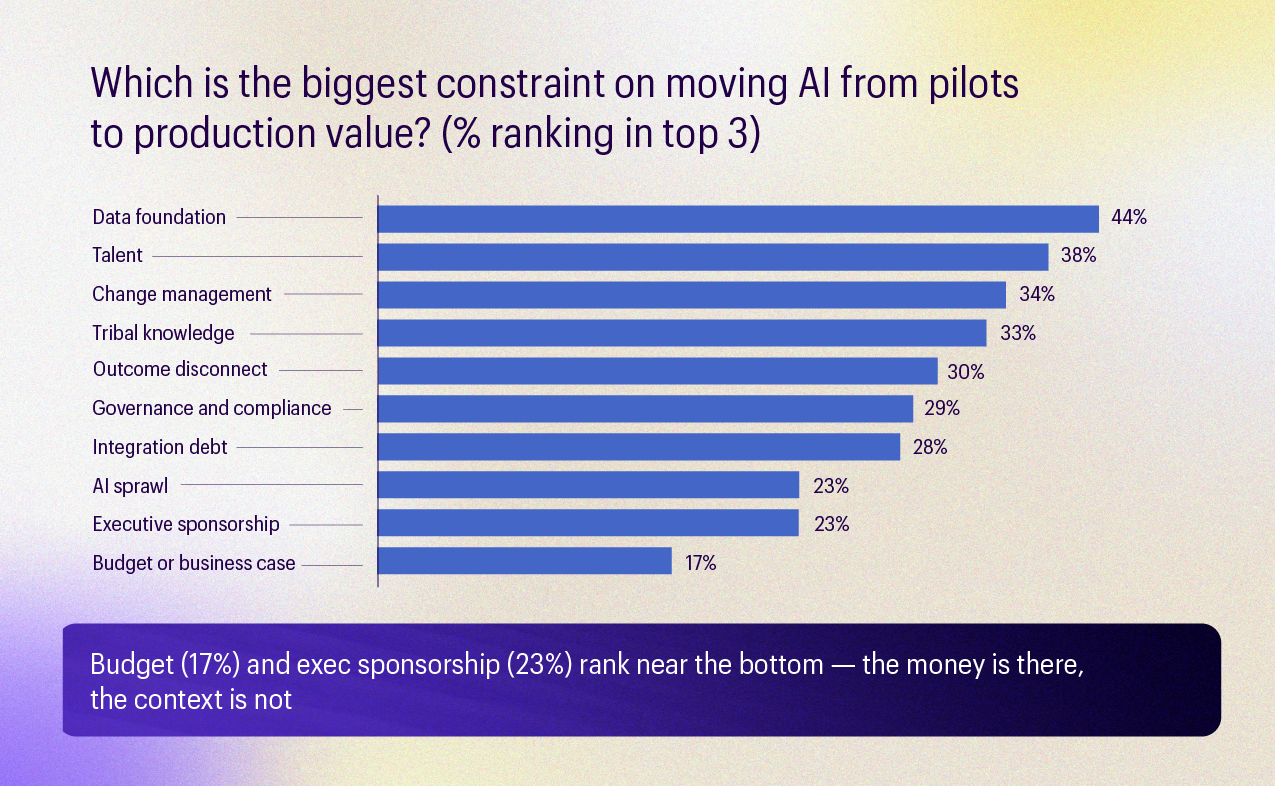
What emerges is not a technology problem, but a context problem. While data foundation (44%) and talent (38%) remain the most cited constraints, they function more as baseline requirements than true differentiators. Most enterprises already recognize their importance and are actively investing in both.
However, the sharper signal sits just behind them. Change management (34%), tribal knowledge (33%), and outcome disconnect (30%) are closely related constraints that, together, highlight how gaps in context are interconnected and reinforce one another throughout the organization. These factors extend beyond technology and infrastructure, indicating a systemic challenge in creating and applying enterprise context across decisions and workflows.
This is where many organizations struggle. AI is deployed into environments where business logic, institutional knowledge, and context are fragmented. Even strong data foundations and capable teams alone can’t consistently translate outputs into enterprise outcomes unless the enterprise context is connected.
An SVP of Enterprise Architecture at a consumer brand noted, “We’ve spent more on consulting fees than on people to sustain the systems once live.”
These findings reveal a truth that leaders can no longer overlook: the enterprise context gap, which leads to interconnected breakdowns in knowledge, decision-making, and execution, limiting AI’s ability to consistently scale.
The Four Constraints Behind Enterprise AI Stagnation
The enterprise context gap becomes more operational when AI is deployed at scale. It does not appear as a single breakdown, but as a chain of connected failures that progressively limit how intelligence scales across the organization.
It starts with the knowledge problem. Much of how enterprises function is undocumented, with critical business knowledge embedded in informal rules, workarounds, and individual judgment calls. Since this institutional knowledge rarely makes its way into enterprise systems, context is often lost at the source.
That missing context affects outcomes. Models may be accurate, but often struggle to earn trust in decision environments. When recommendations are disconnected from the business context in which decisions are made, they become difficult to operationalize. Accuracy does not automatically translate into confidence.
As trust weakens, organizations typically respond by adding more tools rather than fixing the underlying gap. Additional models, copilots, and point solutions are introduced to address isolated problems. This leads to further fragmentation, leaving systems disconnected and insights trapped in silos.
Over time, this fragmentation compounds into platform proliferation and paralyzed action. As more AI systems, platforms, and copilots are layered across functions, enterprises end up with overlapping tools that are difficult to integrate into end-to-end workflows. Even when intelligence exists, it remains spread across disconnected systems, forcing teams to manually bridge gaps between insights, approvals, and execution.
Across this chain, the pattern is consistent. The issue is not the model performance or tools. It’s the lack of a unified enterprise context—where knowledge, decisions, and execution reinforce each other to drive scale.
These constraints should not be viewed as four separate barriers. They represent an interconnected operating pattern in which failures in the enterprise context trigger one another, compounding to stall AI scale. As a result, isolated improvements rarely translate into enterprise-wide impact.
Conclusion
The four constraints reflect a single underlying condition in how enterprise AI is structured and scaled. Improvements in models, talent, or tools fail to yield enterprise-wide results unless this structural condition is addressed.
What most organizations are missing is a Context Layer that connects enterprise knowledge, decision-making, AI systems, and execution. Without it, AI remains fragmented across functions rather than operating as a unified system.
Treating these challenges as isolated optimizes individual parts while the underlying structure stays unchanged. Effort is absorbed locally but rarely produces enterprise impact.
Enterprise leaders must recognize that these are not separate challenges but intertwined expressions of a single structural gap. Addressing constraints separately only shifts, rather than resolves, the main scaling barrier.
Read the complete HFS × MathCo Take5 report to explore the full research findings here.