As AI portfolios continue to expand, business value is proving far more difficult to realize than anticipated. As one CIO from a mid-size retailer observed, “Half of it goes into cleaning up the data estate before anyone touches another model. We’ve got six different systems none of which talk to each other.” The challenge is familiar to many enterprises. While AI initiatives continue to proliferate, the underlying systems, processes, and context required to translate those initiatives into enterprise-wide value often remain fragmented.
The result is a growing disconnect between investment and impact. The issue is not a lack of ambition. It is the distance between where AI portfolios operate today and where leaders expect them to be tomorrow.
To better understand this gap, MathCo partnered with HFS to examine the current composition of enterprise AI portfolios, how they are distributed across different stages of maturity, and the direction organizations expect them to evolve.
The findings reveal a clear pattern. While enterprise leaders increasingly aspire toward workflow-specific and systemic AI, most portfolios remain concentrated in the earlier stages of maturity. Understanding this gap is the purpose of the Task-to-Systemic Curve, a construct that helps visualize where enterprise AI operates today and why business value often falls short of ambition.
The Gap Between AI Reality and Ambition
The disconnect becomes clearer when viewed through the current composition of enterprise AI portfolios.
According to the MathCo-HFS study, 58% of enterprise AI portfolios remain concentrated at the task-specific or use-case-specific level where the impact is limited to individual functions, processes, or decisions. At the other end of the spectrum, only 11% of organizations have reached the systemic stage, where intelligence is integrated across workflows and functions to drive broader enterprise value.
Leadership ambitions, however, tell a very different story. Within the next 24 months, 62% of organizations expect to operate at either the workflow-specific or systemic level. Today, only 25% of organizations operate at those stages, representing a 2.5x leap between current-state deployment and future ambition.
More importantly, the gap extends beyond AI maturity. The greatest returns are unlikely to come from deploying more isolated initiatives. Instead, value increasingly depends on how effectively intelligence is connected across workflows, systems, and decision-making environments.
Task-to-Systemic Curve: The S-Curve of AI Maturity
The Task-to-Systemic Curve helps explain why business value often falls short of enterprise ambition. Rather than measuring progress through the number of use cases, the curve examines how value realization evolves as AI becomes more deeply integrated into the enterprise.
What distinguishes the Task-to-Systemic Curve is that progression is not linear. While organizations can generate value in the earlier stages of the curve, the most significant increase in value realization occurs as intelligence becomes embedded within workflows. This represents an inflection point where AI begins to operate with greater context, connecting decisions and processes rather than optimizing them in isolation.
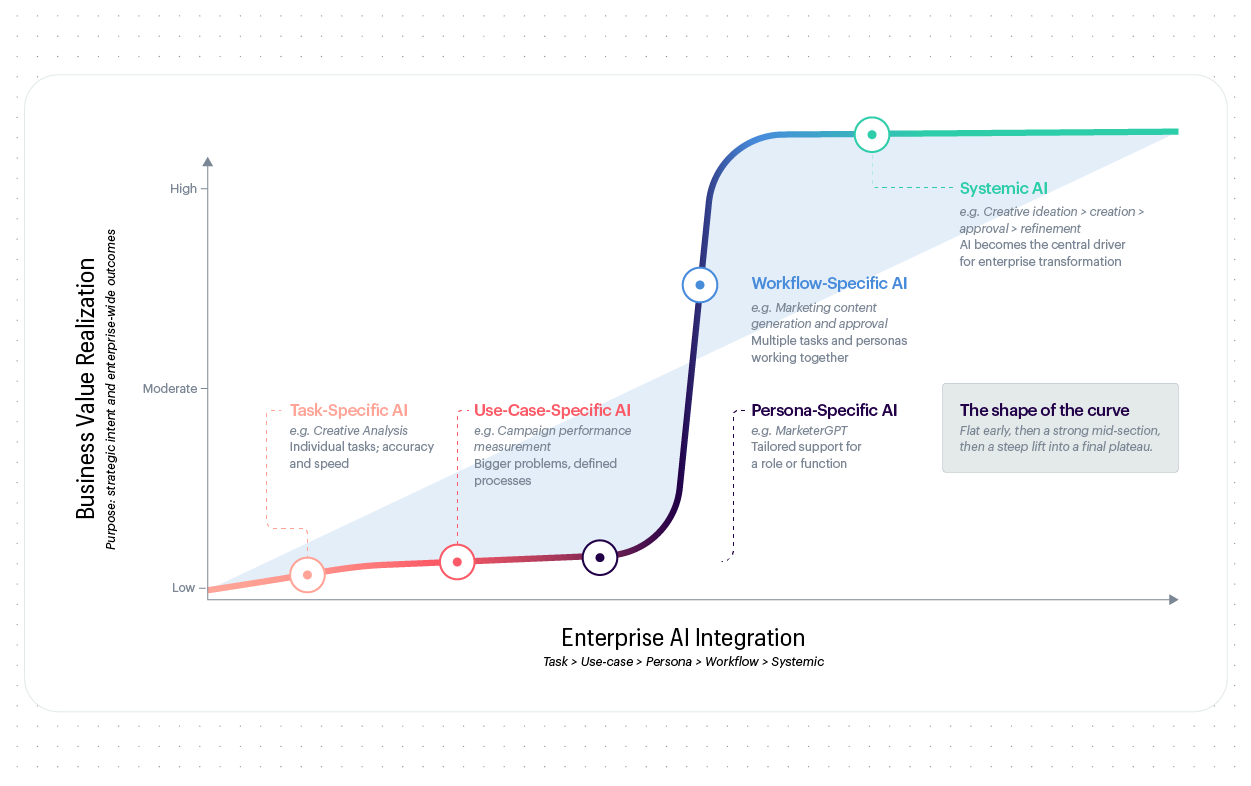
Viewed through this lens, the gap between current reality and future ambition becomes easier to understand. The challenge, therefore, is not simply adopting more AI; it is creating the context, connectivity, and integration required to deliver enterprise-scale value.
Where Does Your Enterprise Sit on the Curve?
The Task-to-Systemic Curve is ultimately a tool for reflection. Rather than measuring the volume of AI activity within an organization, it provides a way to understand how AI initiatives are distributed across the enterprise and what level of value they are positioned to deliver. By visualizing the relationship between AI integration and value realization, the curve offers a clearer perspective on why many organizations struggle to translate growing AI activity into meaningful business impact.
For leaders looking to benchmark their position and explore the broader trends shaping enterprise AI, the Take 5 Report, developed in partnership with HFS, offers deeper insights into where the industry stands today and the opportunities that lie ahead.
Click here to read the report.