Key takeaways and frameworks from MathCo and Lundbeck’s joint poster presentation at PMSA 2026
McKinsey shows that pharma companies adopting Enterprise AI achieve 30% higher HCP engagement through omnichannel orchestration, 40% faster regulatory submissions when automating report drafting, and 3x higher revenue growth per employee when scaling AI across commercial functions. Yet, despite these compelling returns, core operational friction persists across pharma analytics—where delayed insights, analyst bottlenecks, and fragmented metrics leave companies stranded in disconnected point solutions. Bridging this execution gap requires shifting focus to sustainable infrastructure, aligning deployments around a governed data baseline, clear risk mitigation protocols, and repeatable orchestration patterns.
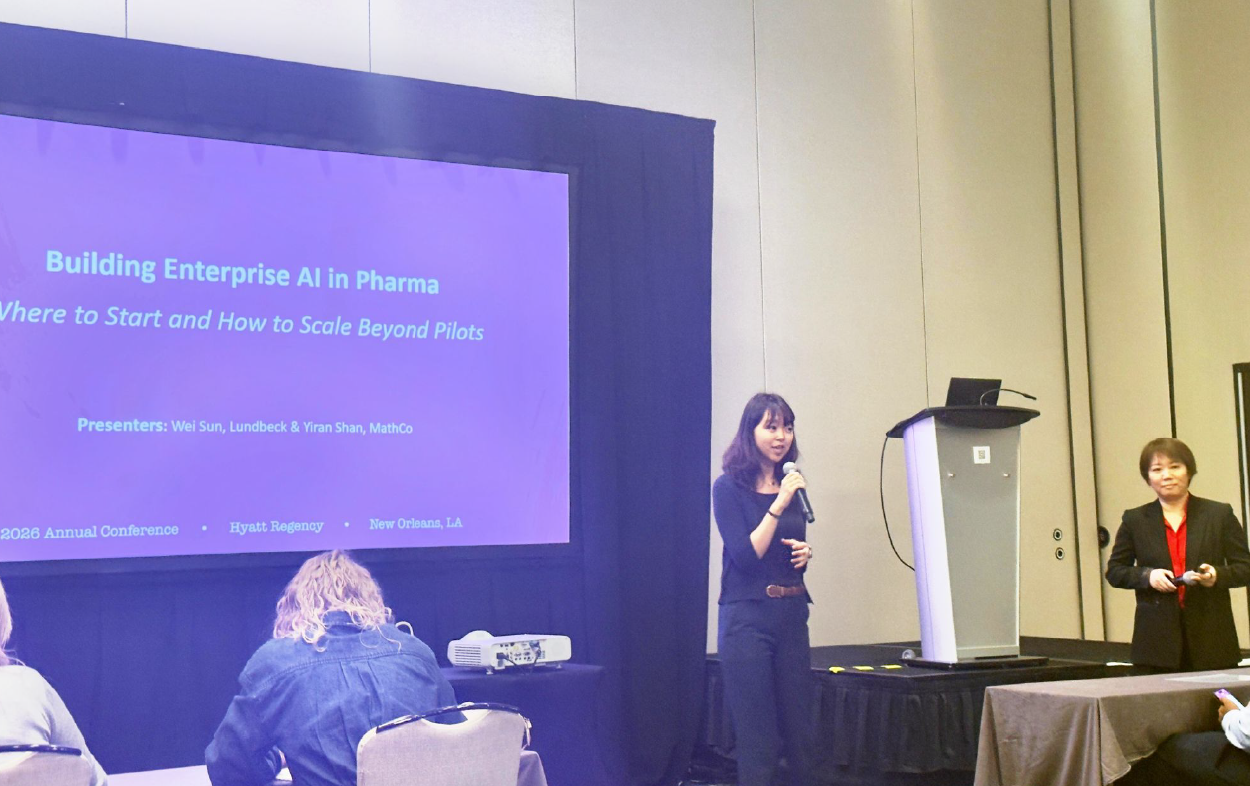
At the PMSA 2026 conference, MathCo and Lundbeck co-presented on this exact operational challenge in a joint session, Enterprise AI in Pharma: Where to Start and How to Scale Beyond Pilots. The session outlined a diagnostic evaluation and an actionable framework for building durable, enterprise-grade AI capabilities.
The Pillars of Enterprise AI
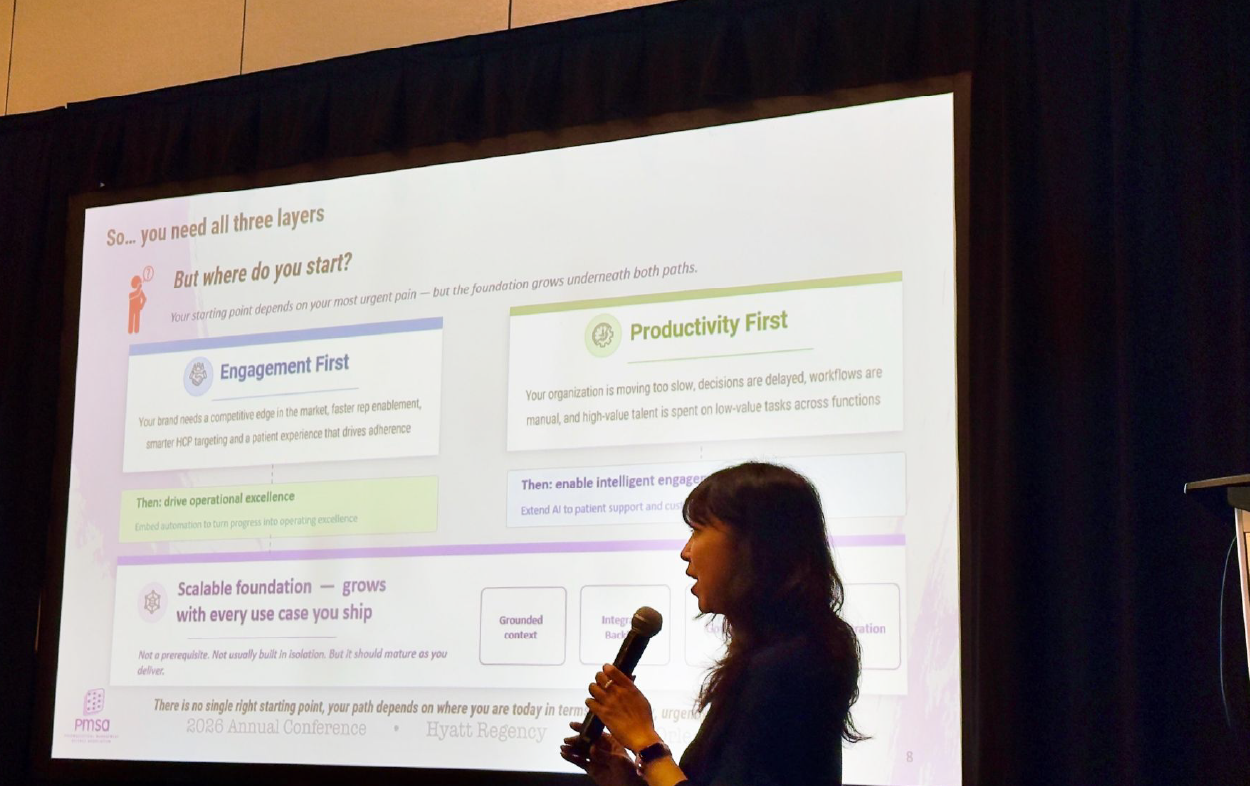
The gap between running AI experiments and running Enterprise AI comes down to three pillars:
- 1st Pillar: Enable intelligent engagement- Deploy customer-facing AI capabilities at scale, patient onboarding agents, a field force concierge, marketing content generation, and market access contract management
- 2nd Pillar: Drive operational excellence- Automate analytical workflows and free expert capacity, which shows up as lower operational costs, minimized incremental hiring, and talent focused on high-value strategic work
- 3rd Pillar: Build a scalable foundation- This foundational layer is built incrementally alongside active use cases rather than upfront in isolation. This foundational layer relies on four essential components: (a) grounded context engineering for precise knowledge, (b) an integration backbone connecting key data systems, (c) a strong governance framework for compliance, and (d) reusable agent templates for scalable orchestration.
The Enterprise AI Transformation and Enablement Story with MathCo and Anthropic
Use Case A: Engagement-First at a Multi-Brand Specialty Pharma
The Challenge: A leading specialty pharma company faced severe field friction because reps and MSLs spent excessive time piecing together fragmented data across legacy systems. Pre-call planning was slow and inconsistent, leaving field teams without clear, actionable insights for HCP meetings.
The Solution: MathCo implemented a multi-model engagement layer, leveraging the Claude Sonnet family alongside OpenAI APIs, to streamline field workflows and build a reliable data foundation.
- Field Note Logging & Insight Capture: An MSL tool built on Claude Sonnet’s structured tool use and function calling parsed unstructured voice and text notes into compliant CRM fields, eliminating manual admin work.
- Data Discovery Layer: A discovery agent powered by Contextual Retrieval allowed cross-functional teams to query data definitions, replacing tribal knowledge with standardized logic across brands.
- AI-on-BI Copilot: Driven by Claude Sonnet’s advanced reasoning capabilities, this copilot lets brand leads execute natural-language queries against live dashboards to retrieve verified metrics in seconds, bypassing traditional analyst queues.
Use Case B: Productivity-First at a Mid-Size Pharma
The Challenge: A mid-size pharma company faced a severe bottleneck in central analytics, where a constant stream of ad hoc business requests delayed critical insights during key commercial execution windows.
The Solution: MathCo deployed agentic workflows and enterprise-grade architecture to streamline analytics demand and support hub operations:
- AI Launch-Readiness Assistant: Built with agentic multi-tool orchestration and prompt caching, this tool automated market access monitoring, competitor tracking, and HCP targeting adjustments without manual analyst intervention.
- Patient Support Navigator: Utilizing Claude Sonnet’s long-context processing, a hub operations tool synthesized patient charts, prior-authorization logs, and communications to flag adherence risks and reimbursement hurdles early.
- Enterprise Foundation & Governance: Connected across various data sources, CRM, and hub datasets, the deployment leveraged enterprise security standards and Anthropic guardrails to ensure zero model training on sensitive data, full auditability, and rapid compliance approval.
The Closing Argument:
None of this holds up without a foundation, and it cannot be retrofitted after the fact. True Enterprise AI requires establishing grounded context, an integrated backbone, strict governance, automated validation, adoption monitoring, and an orchestration baseline from day one. This infrastructure is what separates durable capability from endless experimentation, as a pilot lacking a foundation remains a mere sandbox demo, impressive in presentation, but invisible on the P&L. By cementing these non-negotiable capabilities along whichever entry path addresses immediate operational pain, every subsequent deployment compounds in value across the enterprise rather than forcing the organization to start over.