Data and platform support operations are still heavily dependent on manual investigation and coordination. When data feeds break, downstream tables fall out of sync, or data-quality issues surface, data teams must investigate the root cause. Resolving the issue requires identifying the right fix, implementing it, and validating the outcome.
Much of this work follows familiar patterns, but completing it can require knowledge scattered across logs, systems, support procedures, and the experience of individual team members. Even after the root cause is identified, someone still needs to take the next step.
Resolving operational issues requires more than finding the problem; it requires connecting insight to action. MathCo’s Intelligent Ops or Intelligent Operations brings AI agents into this equation, enabling them to investigate issues, determine appropriate next steps, act within defined controls, and verify results– all under the guiding principles of the customers pre-defined SOPs. This shifts the focus from AI that assists with individual tasks to AI that helps drive the resolution process forward.
Intelligent Ops is designed to bring these steps together: investigating issues, guiding remediation, and taking on routine operational work as the evidence and controls allow.
What is Intelligent Ops and how does it work?
MathCo’s Intelligent Ops uses AI agents to support the operational work involved in investigating incidents and fulfilling support requests. The approach connects incident signals, operational knowledge, diagnosis, remediation, and verification in a continuous workflow.
The workflow follows four steps:
- Detect: Identify an incident or operational issue from available signals.
- Diagnose: Investigate the issue, gather relevant evidence, and determine its likely cause.
- Act: Recommend a resolution or execute an action where the workflow is authorised to do so.
- Verify: Check the outcome and determine whether the issue is resolved or requires further attention.
The degree of autonomy depends on the type of issue and confidence in the proposed resolution. Some cases require a person to make the decision and perform the fix. Others can support a reviewable recommendation. Proven, well-defined cases may be candidates for controlled autonomous execution.
This means the agent does more than generate an explanation. It supports the operational process from the initial signal through the resolution workflow.
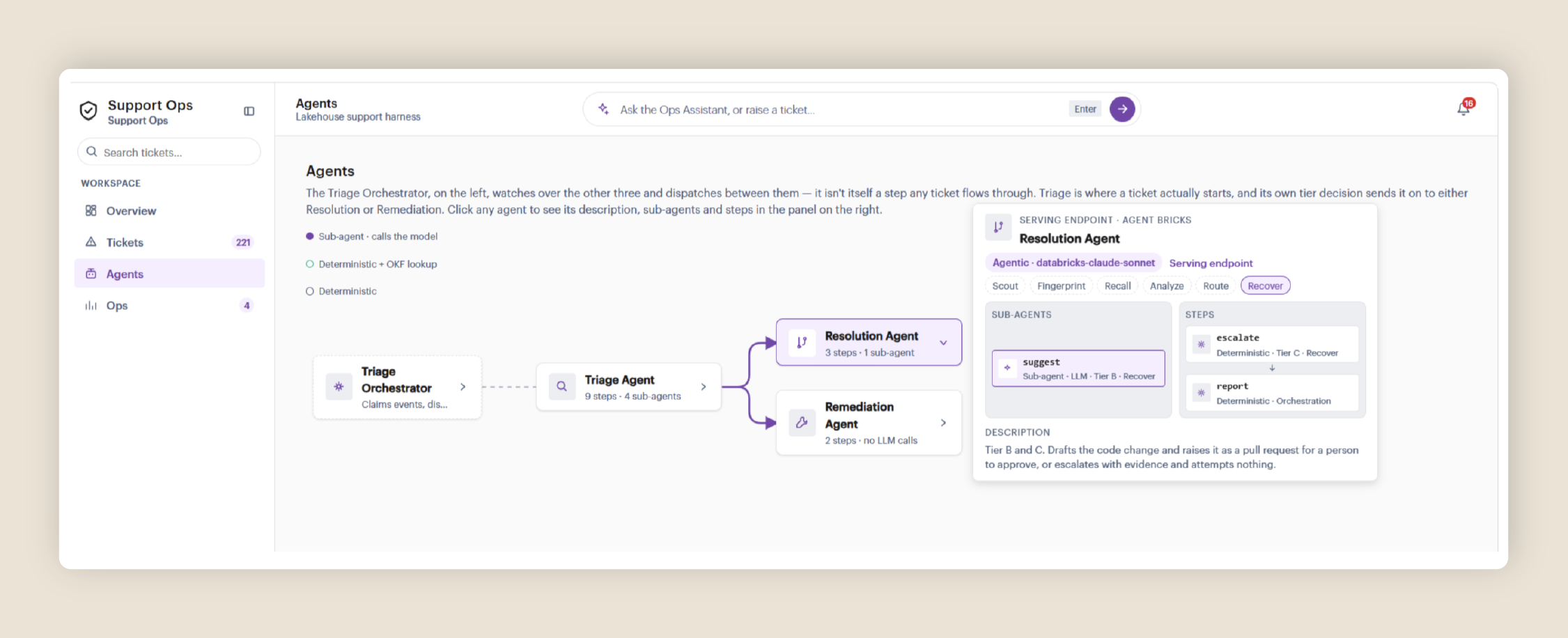
Why operational agents need more than a diagnosis
An operational issue rarely arrives with everything needed to resolve it in one place.
A failed data feed, for example, may be caused by an upstream interruption, a propagation failure, or an issue with the data itself. The initial symptom may be clear while the underlying cause remains uncertain. A proposed fix may also depend on the affected system, the applicable support procedure, and the permissions required to make a change.
An agent that can interpret a ticket or generate a technical suggestion does not automatically have enough information to make a safe operational decision.
To support this work, Intelligent Ops needs to bring together three things:
- Operational evidence: The signals and information needed to understand what happened.
- Relevant context: The procedures, known issue patterns, system relationships, and approved fixes that help interpret the evidence.
- A controlled path to action: The permissions, review steps, and verification needed to carry out a resolution responsibly.
The quality of the outcome depends on how these elements work together. A plausible diagnosis is useful, but a diagnosis supported by evidence and connected to a controlled resolution process is much more actionable.
How does an agent investigate and resolve an issue?
Consider a recurring incident in which data is not reaching a downstream system as expected.
The operational workflow can proceed as follows.
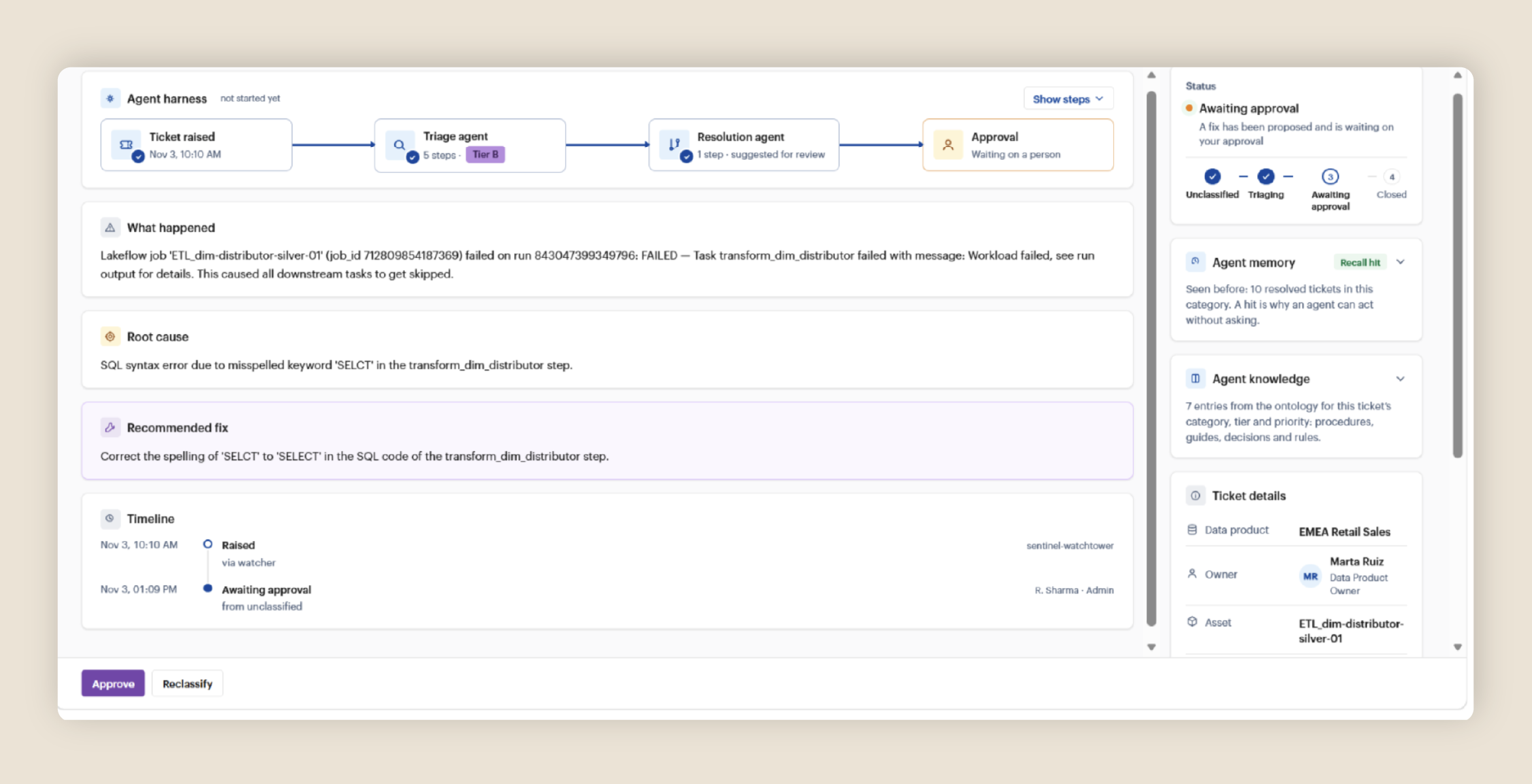
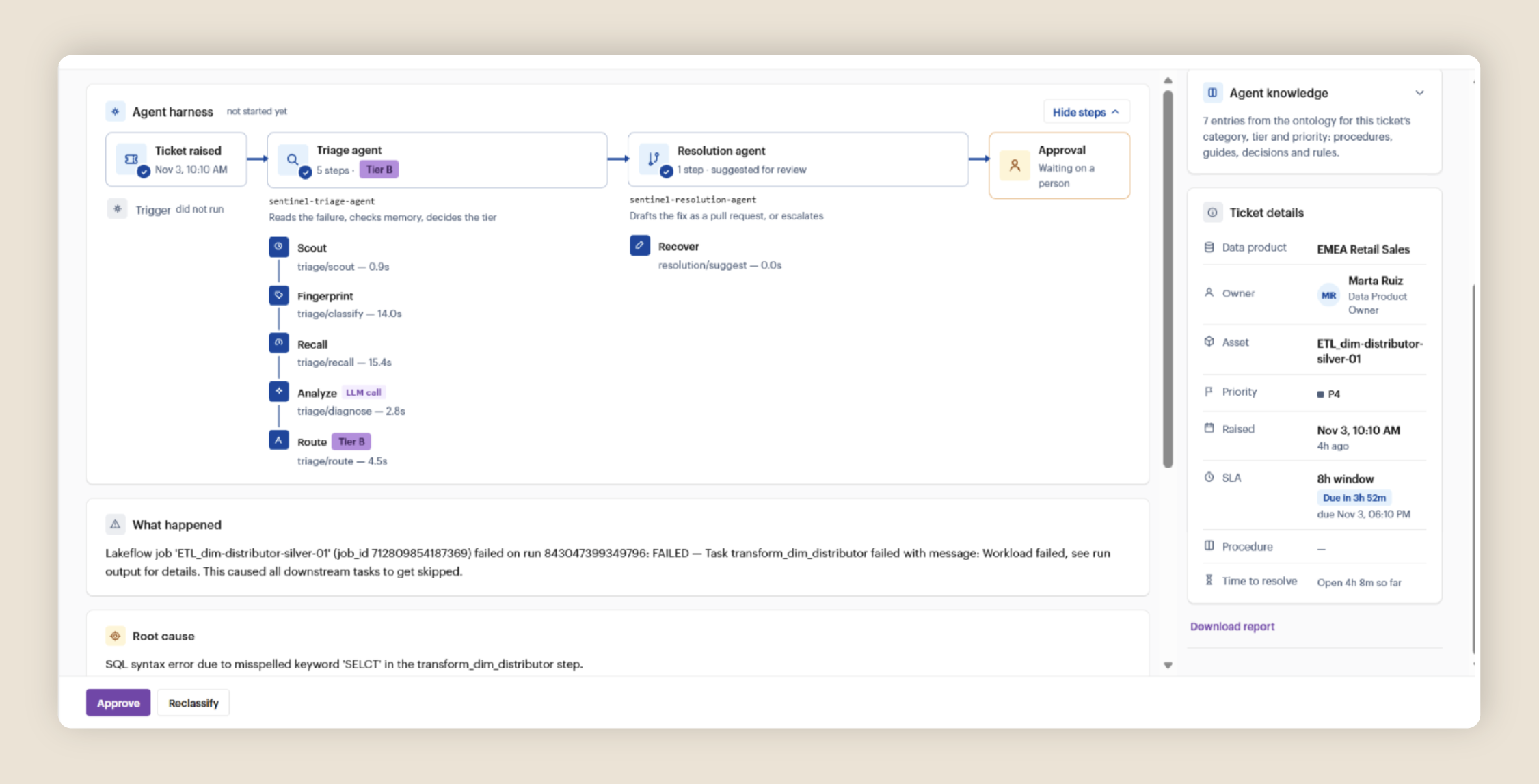
- Detect the issue
The agent identifies the failure from available operational signals or an incoming support incident. It establishes what is affected and gathers the information required to begin the investigation.
- Investigate the cause
The agent examines the available evidence, identifies relevant systems and dependencies, and compares the symptoms with known issue patterns and support procedures. It assembles a root-cause hypothesis and evidence supporting it.
- Determine the next action
Based on the diagnosis and the applicable controls, the agent identifies a suitable next step. It may provide findings and evidence to a support engineer, prepare a proposed fix for review, or proceed with an explicitly authorised action.
- Verify the result
After the action is taken, the workflow checks whether the expected outcome has been achieved. If the issue persists, the evidence is inconclusive, or an exception occurs, the case can be escalated for further investigation.
This creates a connected workflow in which diagnosis informs action and the result informs what happens next.
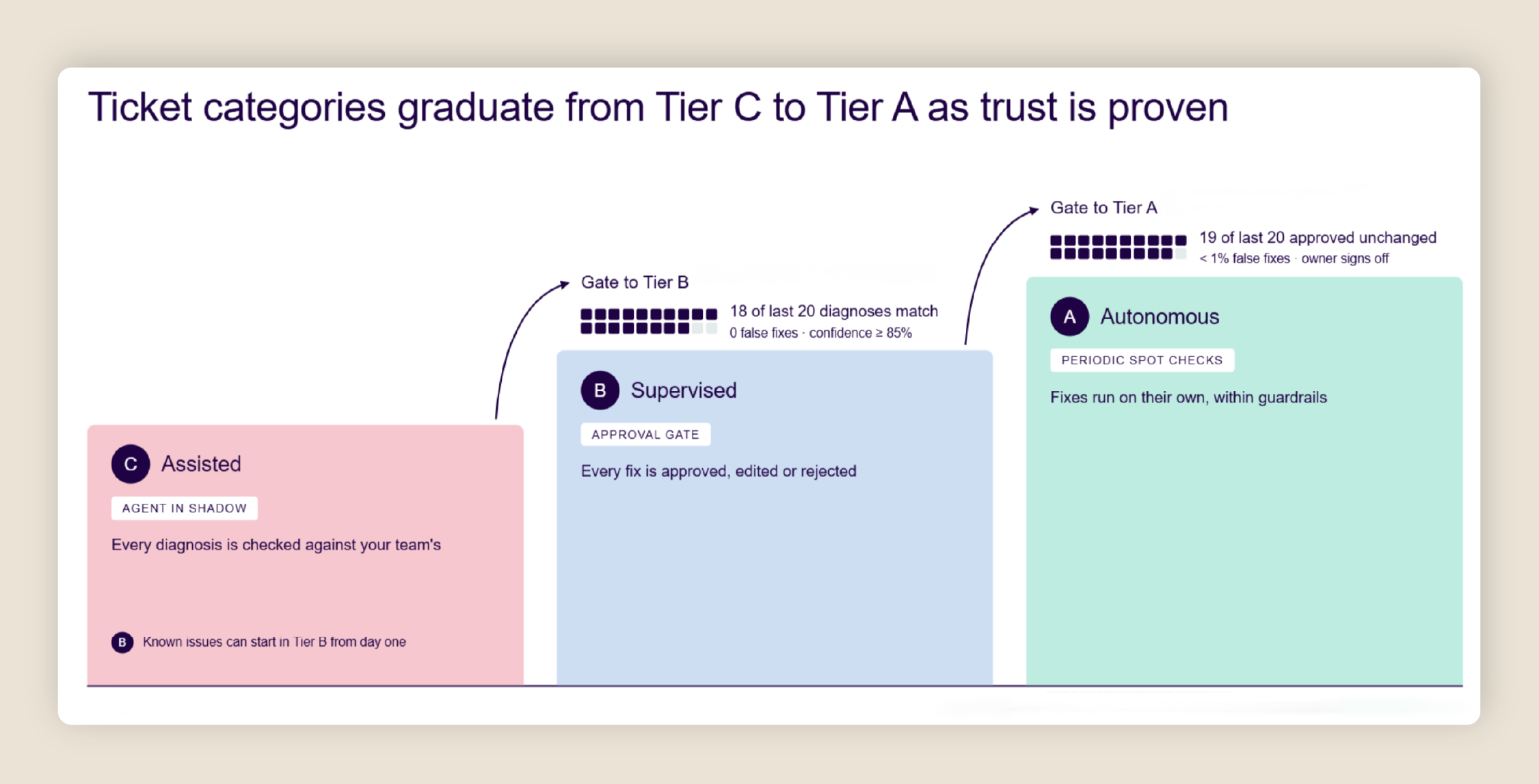
How much should the agent do on its own?
Different operational tasks call for different levels of autonomy. A known, repeatable failure is not the same as an issue involving uncertain causes or a decision that requires business judgment.
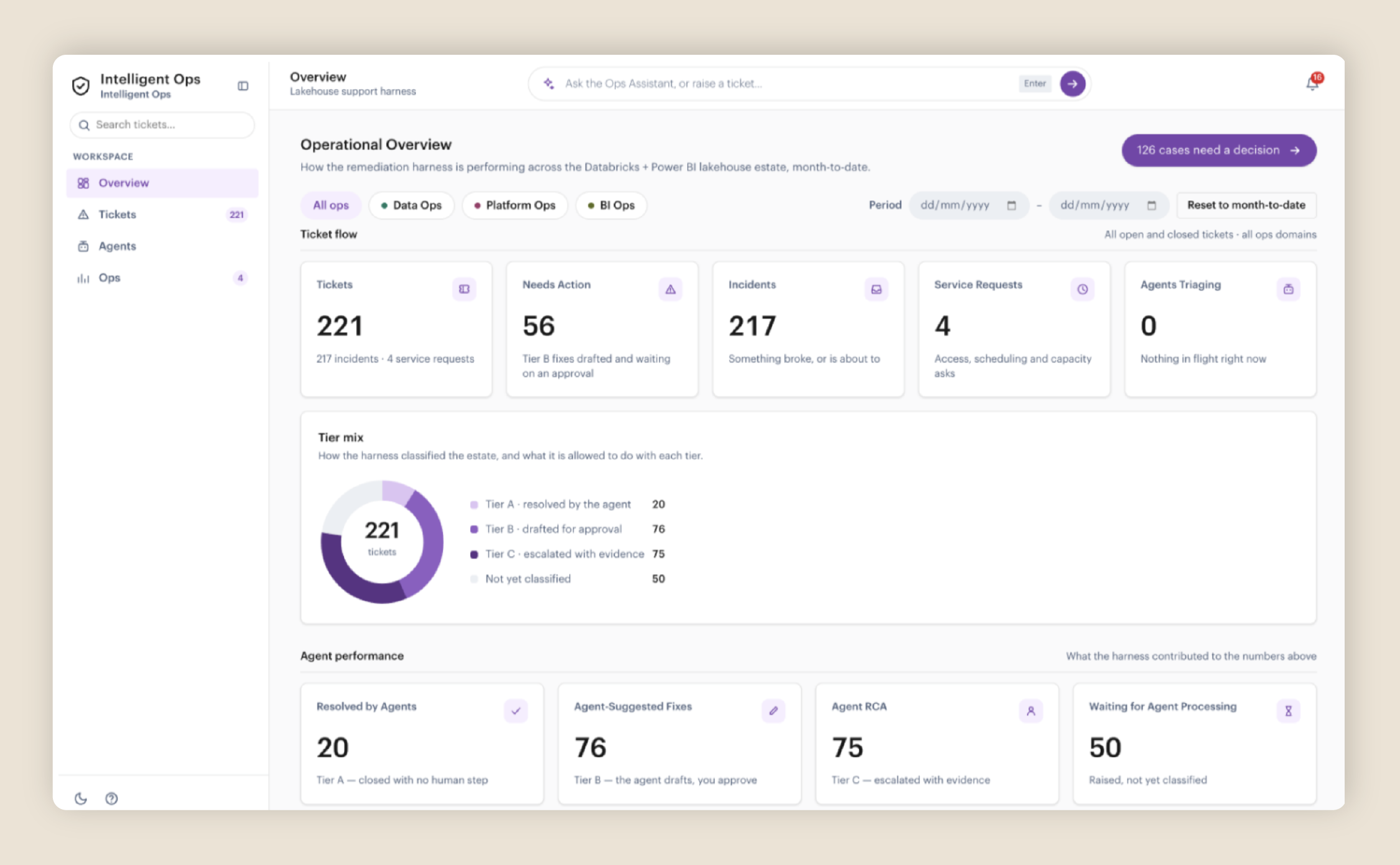
Intelligent Ops uses three levels to define how responsibility is shared between the agent and the human operator.
- Tier C – Assist
The agent investigates the issue and provides a diagnosis, root-cause analysis, and supporting evidence. A person decides how to proceed and performs the resolution.
This is appropriate when the diagnosis is uncertain or the resolution requires human judgment.
- Tier B – Propose
The agent prepares a recommended fix that a person can review, approve, edit, or reject before execution.
This is appropriate when the issue is sufficiently understood for the agent to recommend a specific action, but human approval is still required.
- Tier A – Execute
The agent performs a pre-approved action within defined boundaries, verifies the outcome, and escalates when the workflow encounters an exception.
This is appropriate only when the fault pattern and permitted action are sufficiently well established to support autonomous execution.
The transition between these tiers is based on evidence rather than assumption. A workflow can begin with human-led resolution, progress to agent-generated recommendations, and move to autonomous execution when the relevant diagnosis and action have demonstrated sufficient reliability.
How do you keep autonomous execution under control?
Giving an agent permission to investigate an issue does not mean giving it unrestricted permission to change operational systems.
Intelligent Ops incorporates a graduated approach in which the allowed actions depend on the maturity and risk of the workflow.
Before a workflow advances to greater autonomy, its performance should be evaluated against observed outcomes. Moving from assistance to proposed remediation requires evidence that the agent’s diagnoses are sufficiently accurate and that its recommendations are appropriate. Moving to autonomous execution requires a confirmed fault signature, an allowlisted action, and explicit sign-off.
For autonomous workflows, controls include:
- Allow listed actions: The agent can execute only explicitly permitted fixes.
- Attempt limits: Repeated remediation attempts are constrained.
- Verification: The outcome is checked after execution.
- Escalation: Uncertain cases and exceptions are routed to a person.
- Kill switch: Execution can be stopped when necessary.
- Human oversight: People retain responsibility for approvals, risk decisions, and operational accountability.
These controls allow teams to expand automation incrementally without treating every incident as a candidate for autonomous resolution.
How does Intelligent Ops use operational knowledge?
Operational procedures and known fixes are valuable only if an agent can identify the relevant information, interpret it correctly, and use it appropriately.
The Intelligent Ops concept includes a structured process for turning raw operational information into a governed knowledge bundle.
- Harvest collects source signals and material without prematurely assigning meaning.
- Understand organizes the material into named concepts, verified queries, candidate error fingerprints, linked standard operating procedures, and relevant systems.
- Check combines human approval of classifications with automated integrity checks.
- Publish assembles a versioned update to the knowledge bundle. The update is not merged into the approved version until a person approves it.
This process creates a controlled route for maintaining the knowledge used by operational workflows. It also recognises that new information should not automatically become approved operational guidance simply because an agent has identified it.
What operational work can Intelligent Ops support?
The initial focus is on recurring support work where better investigation, clearer evidence, and a more structured resolution process can reduce manual effort.
Examples include investigating data that has stopped flowing downstream, examining inconsistencies between source and downstream data, and gathering evidence for data-quality or key-integrity issues.
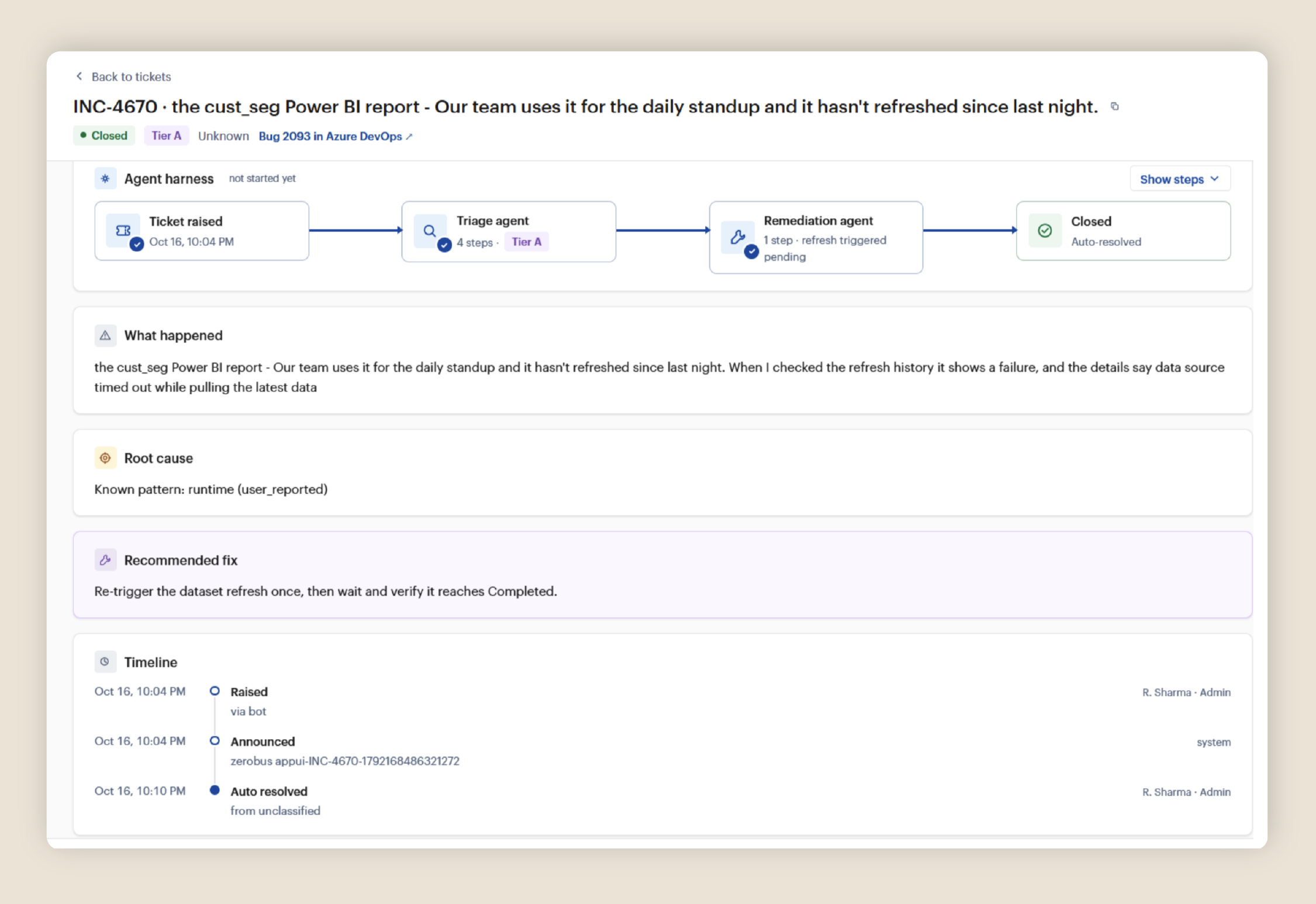
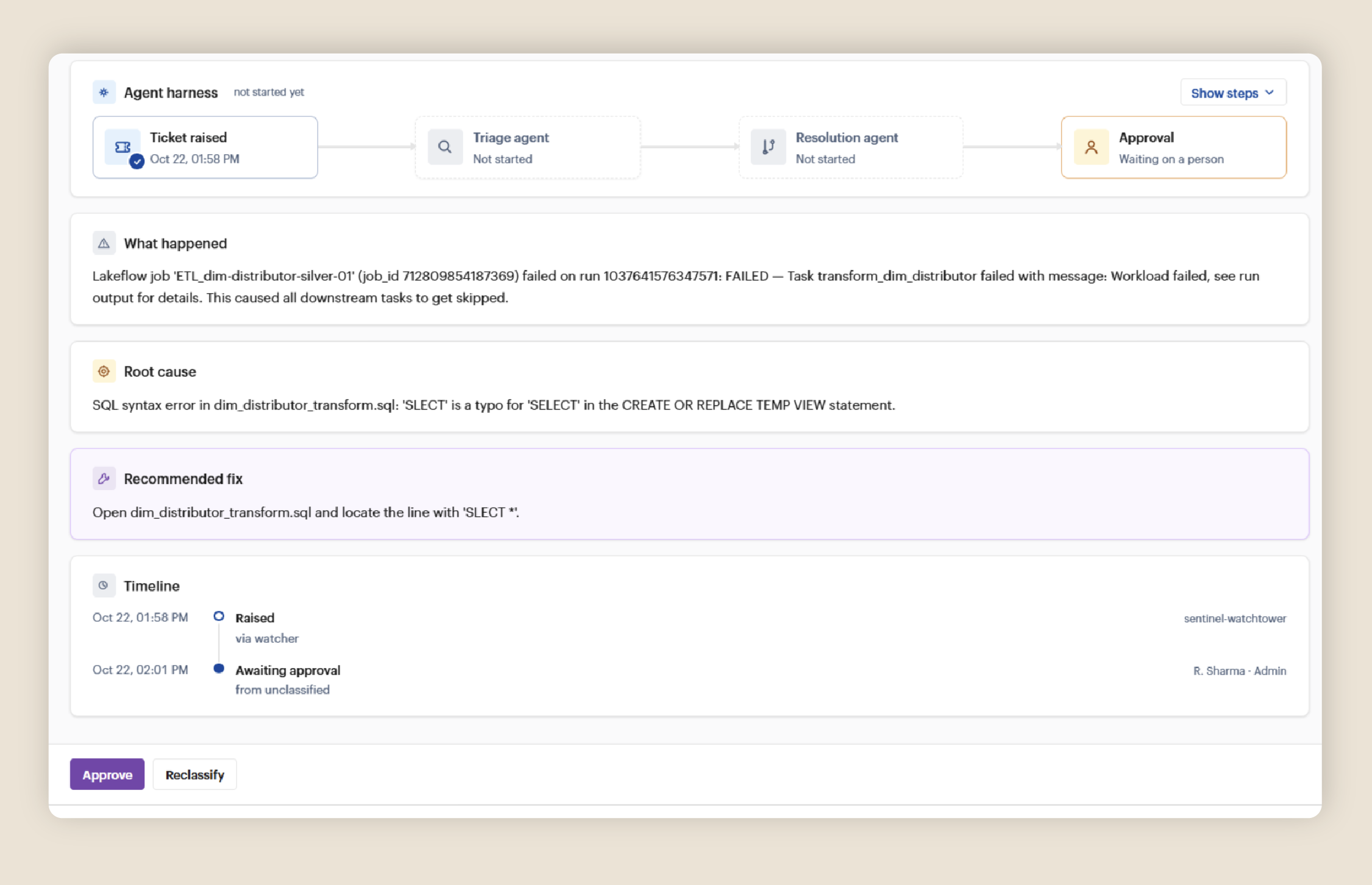
These cases do not all require the same level of autonomy. A recurring ingestion failure may eventually support a predefined automated fix, while a data-quality issue may initially benefit more from reconciliation, diagnosis, and evidence presented to a data owner.
The same principles can also apply to routine support requests, such as approved backfills, access changes, data-feed onboarding, and schedule changes. Each workflow can follow its own rules for context gathering, approval, execution, and verification.
The objective is to automate the appropriate parts of the work while keeping decisions and actions within the boundaries established for each use case.
Frequently asked questions
Q1: Does Intelligent Ops automatically fix every incident?
No. The level of autonomy depends on the issue, the available evidence, and the controls established for the workflow. Some cases remain human-led, some require approval before execution, and selected proven cases may support autonomous action.
Q2: How does Intelligent Ops handle uncertain diagnoses?
When the cause or appropriate response is unclear, the workflow can provide its findings and supporting evidence for human review rather than proceed with an unverified action.
Q3: How are autonomous actions constrained?
The proposed operating model uses allow listed actions, attempt limits, verification, escalation, and a kill switch. Autonomous execution is intended for workflows that meet defined readiness criteria.
Q4: Can operational knowledge be updated automatically?
The context-layer approach includes automated integrity checks and a human approval step before a knowledge-bundle update is published.
Q5: What types of operational issues can Intelligent Ops address?
Intelligent Ops is designed to support recurring operational challenges such as data-feed failures, downstream data inconsistencies, data-quality issues, and routine support requests. Each workflow follows its own rules for investigation, approval, execution, and verification.
Q6: Can Intelligent Ops complement existing capabilities from platform providers?
Yes. Intelligent Ops is designed to complement existing platform capabilities by connecting operational signals, enterprise-specific knowledge, investigation, remediation, and verification into a more coordinated workflow. Rather than replacing the tools and capabilities teams already use, it can help build on them by bringing context and controlled AI-driven actions into existing operational processes. This allows organizations to extend their current capabilities while maintaining the governance, approvals, and human oversight required for reliable execution.