Retail organizations today are investing heavily in AI, cloud modernization, and real-time analytics capabilities to drive faster and more intelligent decisions. Yet despite these advances, many retailers still face a fundamental challenge: different teams continue to operate with different versions of the truth. Metrics vary across functions; business logic gets recreated repeatedly, and decision-making slows under the weight of inconsistent data interpretation.
As retail analytics evolves toward increasingly AI-driven and self-service environments, the need for a shared business language is becoming critical. This is where the semantic layer is emerging as a foundational capability for modern retail enterprises.
Retail’s Data Paradox: Rich in Data, Starved for Meaning
Modern retailers generate enormous volumes of operational and customer data across stores, digital channels, supply chains, loyalty ecosystems, and supplier networks. However, scale alone does not guarantee alignment. Business users across merchandising, finance, marketing, and operations often interpret the same metrics differently depending on the systems, dashboards, or teams they rely on.
Questions as fundamental as sell-through, active customer definitions, inventory availability, or promotional impact can produce conflicting answers across the organization. The issue is rarely a lack of data infrastructure. In most cases, retailers already possess mature cloud ecosystems and reporting platforms. The real challenge lies in creating a governed and consistent interpretation layer between raw data and business decision-making.
What Is a Semantic Layer, and Why Does Retail Need One Now?
A semantic layer is the abstraction sitting between raw data models and business consumers. It encodes business logic, metric definitions, entity relationships, and hierarchies into a governed, reusable layer that any downstream tool can consume consistently.
In retail, this means encoding constructs like gross margin versus net margin versus contribution margin, defined once across all reporting surfaces; product hierarchies that reconcile differences between ERP item masters, vendor catalogs, and customer-facing category structures; and customer segment definitions shared between the loyalty team, the media buying team, and the supply chain replenishment model.
The urgency is compounded by the shift toward conversational and agentic analytics interfaces. As retailers invest in AI copilots for category managers and buyers, the semantic layer becomes the ceiling on what those tools can reliably deliver. An AI agent is only as trustworthy as the data context it is grounded in.
Read our Semantic Layer whitepaper here.
The Role of AI in Accelerating Development
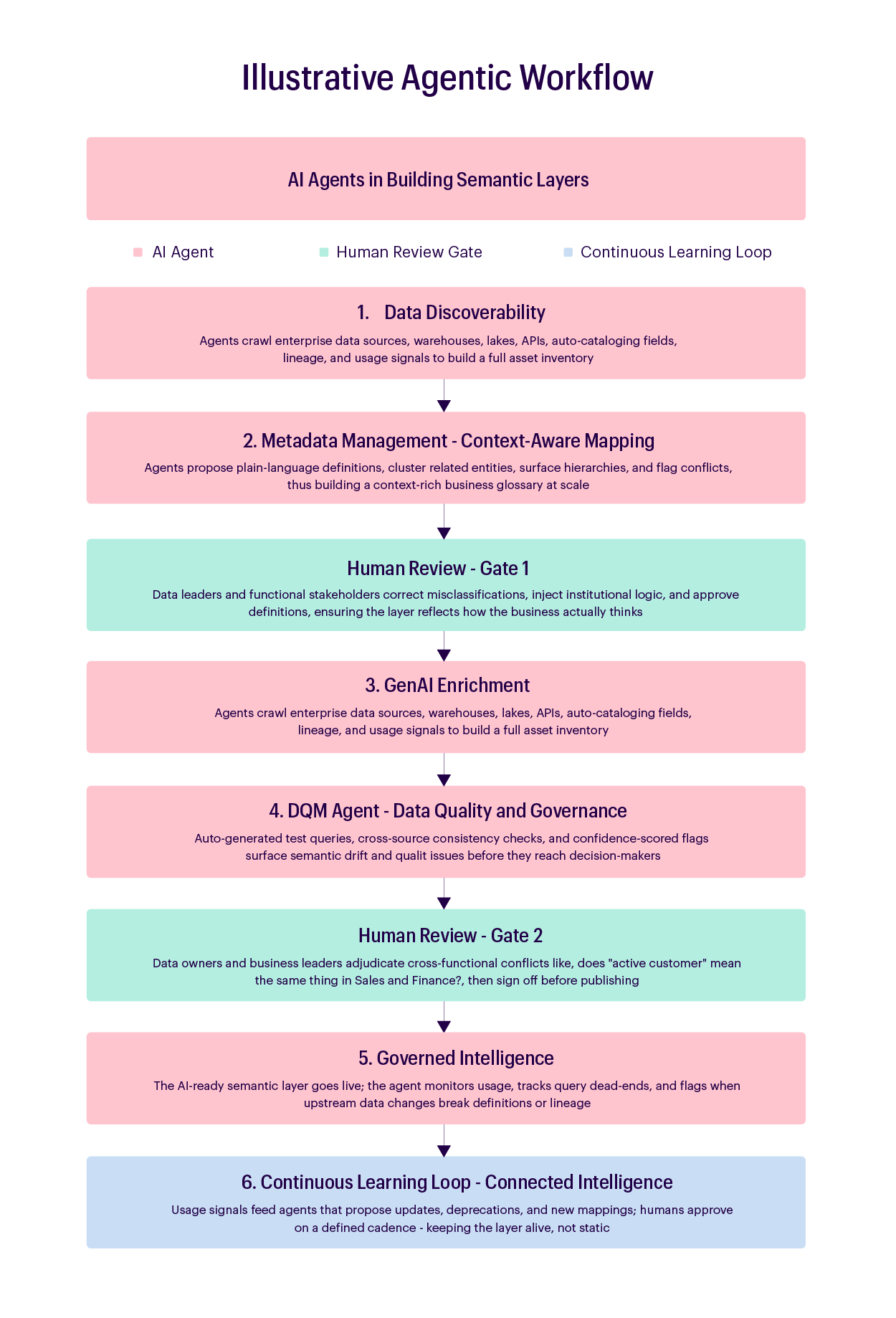
Historically, building a semantic layer has been a very manual endeavor, requiring specialist modelers and extended stakeholder engagement to codify logic into governed definitions. AI-assisted development changes this. Specific agents trained on business context and data schemas can auto-suggest metric definitions by inferring business intent from column names and relationships, identify semantic conflicts across existing models, and generate plain-language documentation for metrics. AI tooling reduces the build timeline from months to weeks.
Where the Impact Is Felt Across Retail Functions
Merchandising and Category Management: Category managers depend on metrics such as sell-through rates, space productivity, assortment performance, and price index versus competition to make rapid commercial decisions. When these metrics are defined inconsistently across planning tools, reporting layers, and optimization models, teams lose time reconciling numbers and confidence in decision-making declines.
A semantic layer encoding product hierarchies, promotional flags, store clustering logic, and pricing constructs enables merchandising teams to access governed metrics through self-service analytics environments while improving consistency across commercial planning workflows.
Supply Chain and Inventory: Supply chain functions operate at the intersection of demand signals, supplier lead times, inventory positions, and fulfillment constraints. However, these ecosystems often span multiple disconnected systems, creating inconsistencies in how operational metrics are interpreted across teams.
A semantic layer creates a shared vocabulary across these systems, ensuring concepts such as “available inventory” are interpreted consistently across warehouse management systems, allocation tools, and planning dashboards. It also enables standardized definitions for critical supply chain metrics such as OTIF, fill rate, and demand signal interpretation, improving alignment across planning, replenishment, and fulfillment workflows.
Marketing and Customer Analytics: Retail marketing effectiveness is frequently undermined by fragmented customer identity resolution and inconsistent segment definitions. A semantic layer encoding loyalty tier logic, RFV calculations, and channel attribution rules enables teams to operate from a single governed view of customer behavior, for example, when evaluating a personalization program or measuring campaign-driven basket size lift.
Store Operations: Single source of truth and standardized KPI definitions for store managers deployable across formats; and foot traffic metrics reconciled across sensor, loyalty, and transaction data sources.
As stores increasingly serve as omnichannel fulfillment nodes, operational KPIs like pick rate, order readiness time, and SLA compliance can fragment across OMS, WMS, and store task management systems. A semantic layer ensures these metrics are calculated consistently regardless of which fulfillment mode or system generated the underlying transaction.
Where to Begin Today?
The pragmatic entry point is a high-pain domain where metric inconsistency is already costing decisions: commercial trading performance (where finance and commercial teams regularly conflict), customer and loyalty analytics (where personalization ambitions outpace data alignment), or inventory availability (where conflicting stock signals slow operational calls). From this anchor domain, the semantic layer extends incrementally – metric by metric, domain by domain.
Over time, this evolves into a shared analytics foundation capable of supporting not only traditional reporting, but also AI-driven decision intelligence at scale.
In the coming years, competitive advantage in retail will increasingly depend on an organization’s ability to operationalize AI against a consistent and trusted business context. As AI-powered analytics become embedded across merchandising, supply chain, marketing, and store operations, semantic consistency will evolve from a data governance concern into a foundational requirement for enterprise agility and scalable AI adoption.
At MathCo, we bring retail domain expertise, AI-accelerated development, and proven data governance approaches together to help retailers move from fragmented metric environments to a coherent analytics foundation. In a retail landscape where AI-powered analytics are moving from pilots to production, the semantic layer is no longer background infrastructure; it is a strategic asset.
To learn more about our solutions in the retail space, click here.